The Intelligence Assembly Tax: A Framework for Unified Competitive Signal Infrastructure


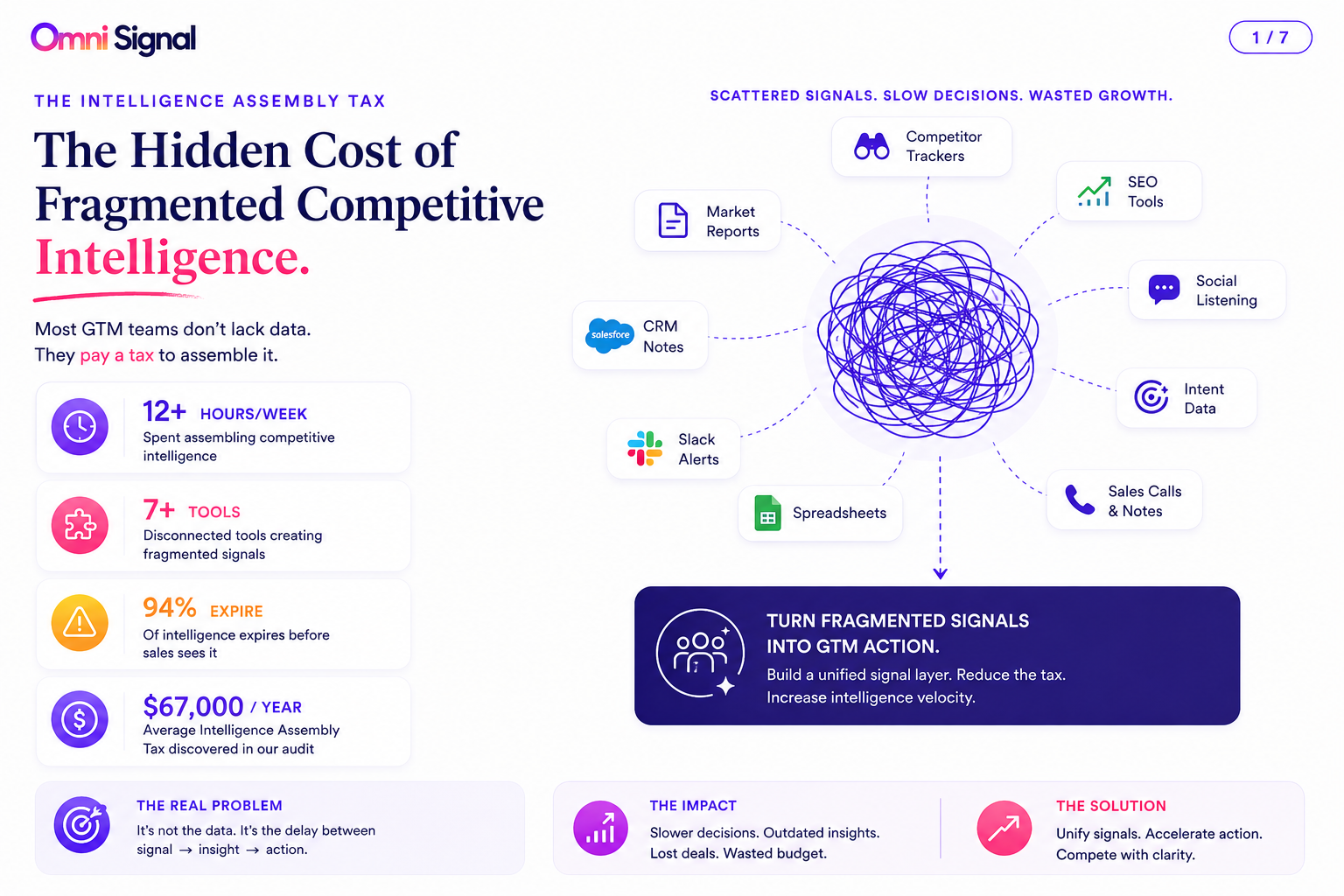
Most B2B GTM teams do not have a competitive intelligence problem.
They have an intelligence assembly problem.
Competitive signals are scattered across competitor trackers, SEO tools, Slack alerts, CRM notes, sales calls, spreadsheets, LinkedIn posts, and battlecards. Each tool provides useful data, but the workflow around them is fragmented.
After auditing 50+ GTM stacks, we found the same pattern:
- 7+ disconnected tools
- 12 hours per week spent assembling intelligence
- battlecards updated too late
- duplicate research across sales, marketing, and product
- insights expiring before sales can use them
In one audit, the annual cost reached $67,000.
The painful part: 94% of that spend produced intelligence that expired before sales saw it.
That hidden cost is what we call the Intelligence Assembly Tax.
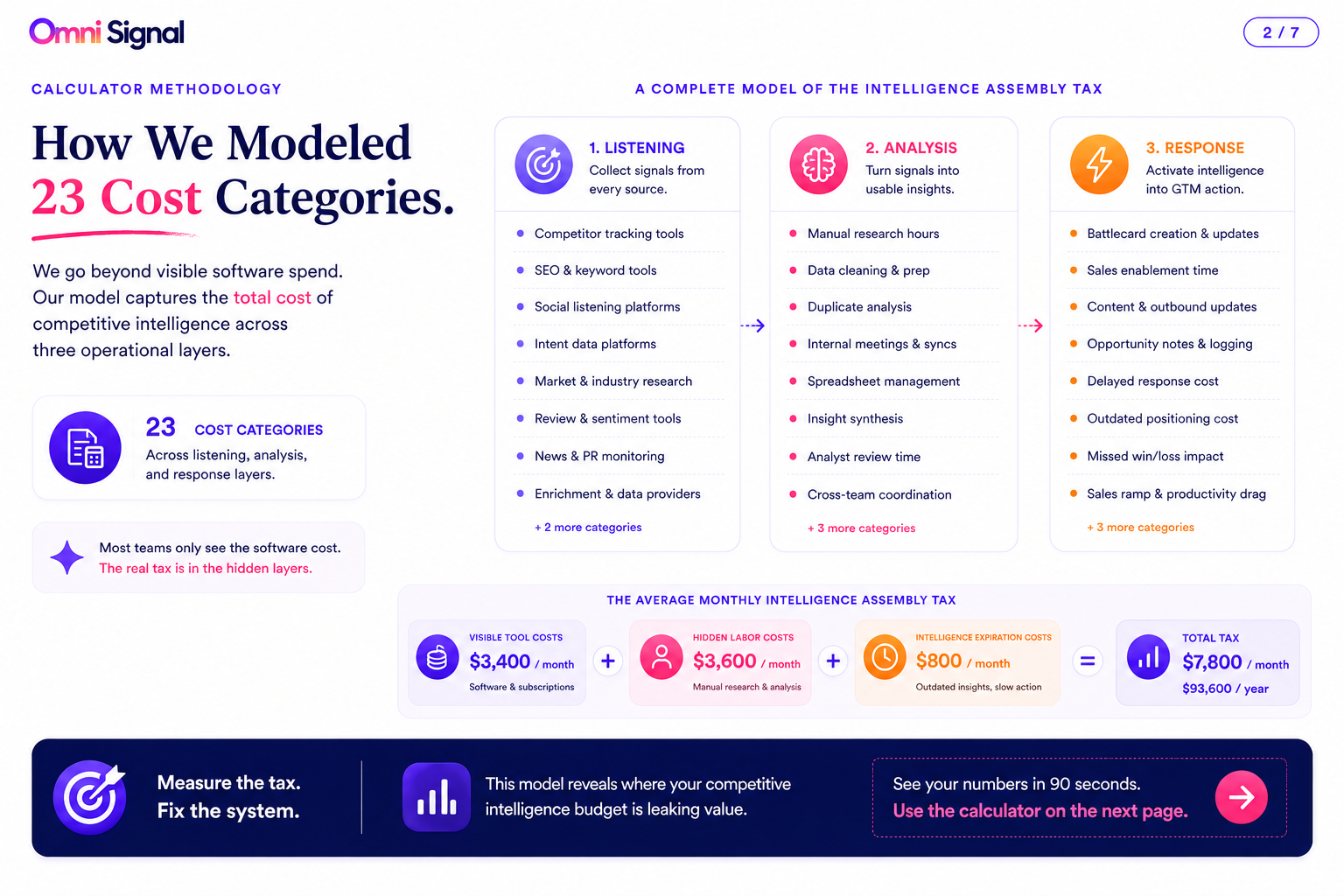
Calculator Methodology: How We Modeled 23 Cost Categories
Most teams only count visible software spend.
But the real cost includes tools, labor, coordination, and delay.
Our calculator models 23 cost categories across three layers:
- Listening — tools and sources used to monitor competitors, markets, reviews, content, SEO, and social activity.
- Analysis — manual research, duplicated synthesis, meetings, spreadsheets, and product marketing review.
- Response — battlecard updates, sales enablement, outbound changes, content briefs, and delayed activation.
Across audited teams, the average monthly cost looked like this:
- $3,400 in visible tool costs
- $3,600 in hidden labor costs
- $800 in intelligence expiration costs
The goal is simple: show where competitive intelligence is leaking time, money, and speed.
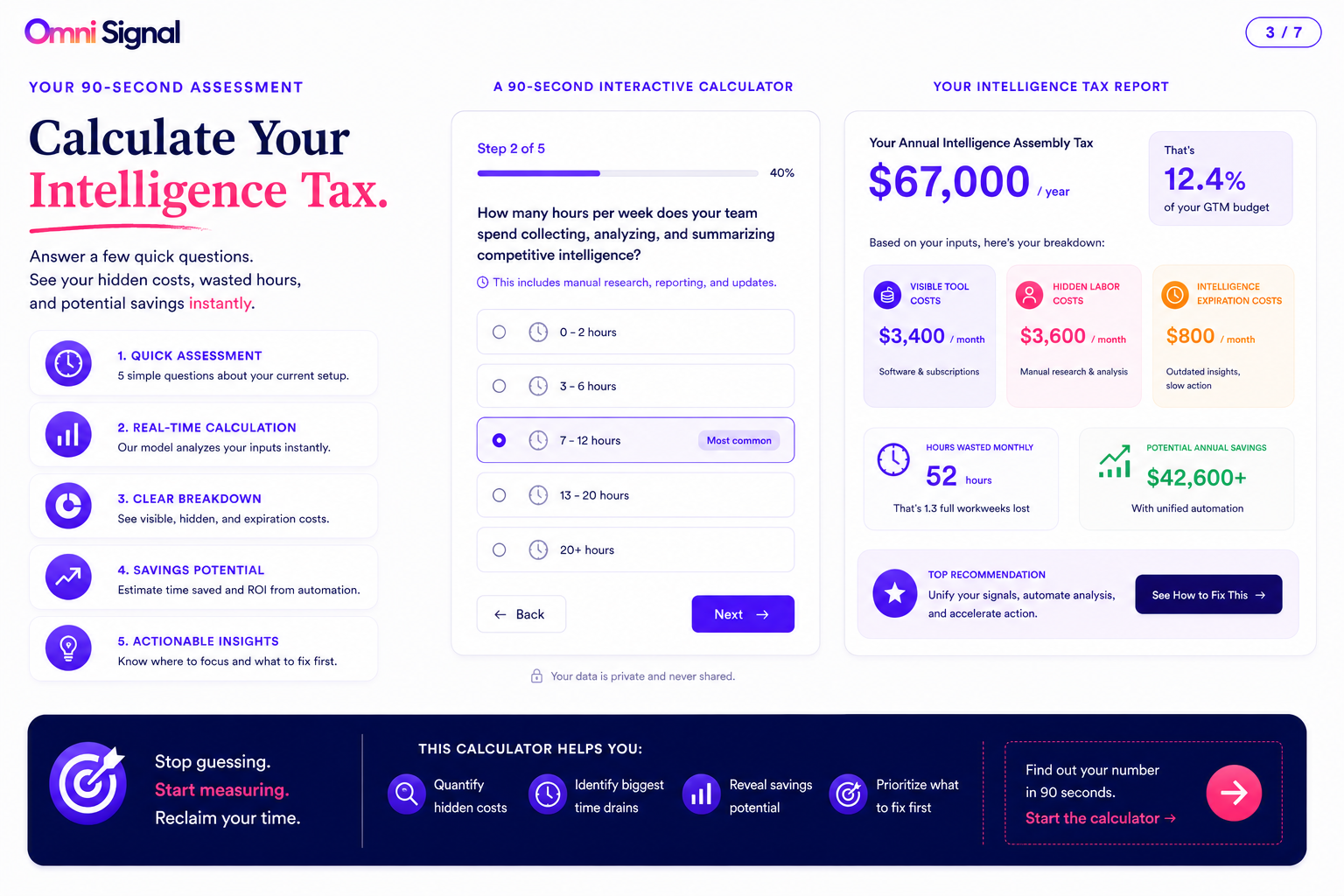
Your 90-Second Assessment: Interactive Calculator Walkthrough
The calculator helps GTM teams estimate their own Intelligence Assembly Tax in under 90 seconds.
It asks practical questions:
- How many tools do you use for competitive intelligence?
- How many hours per week are spent collecting and summarizing signals?
- How often are battlecards or sales notes updated?
- How many people touch the workflow?
- How quickly do insights turn into action?
The output shows:
- monthly visible software cost
- hidden labor cost
- intelligence expiration cost
- annual tax
- hours wasted per month
- estimated savings from automation
It gives your team a baseline before changing the stack.
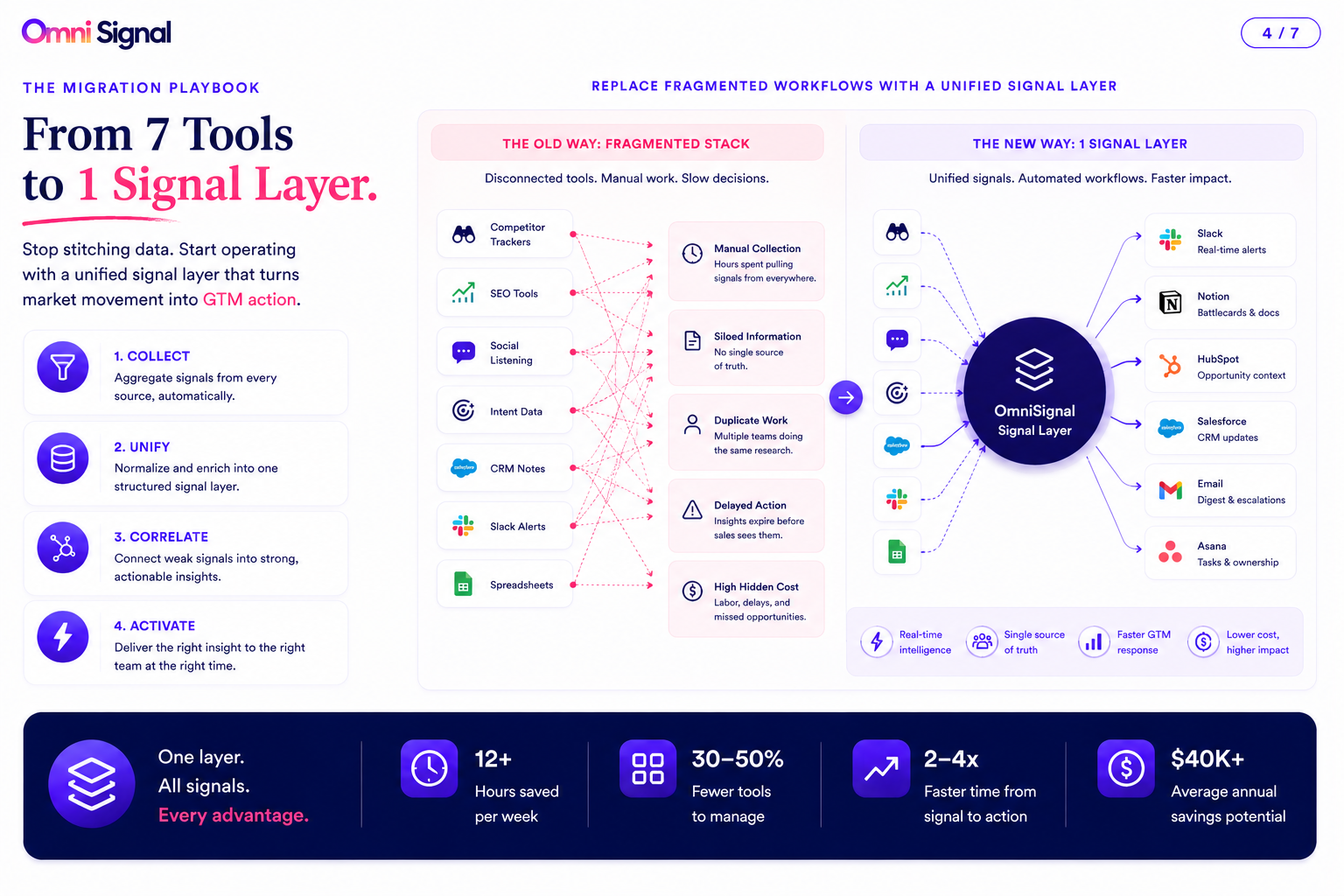
The Migration Playbook: From 7 Tools to 1 Signal Layer
The goal is not to remove every tool overnight.
The goal is to replace fragmented workflows with one unified signal layer.
A signal layer should:
- Collect signals from multiple sources
- Normalize them into one structure
- Correlate them with GTM priorities
- Activate them inside sales and marketing workflows
Example:
Instead of a competitor pricing change becoming a Slack alert, then a spreadsheet note, then a meeting topic, then a late battlecard update…
It becomes a structured signal that triggers:
- priority classification
- owner assignment
- sales context update
- battlecard task
- suggested objection response
- content or outbound angle
That is the difference between collecting intelligence and operationalizing it.
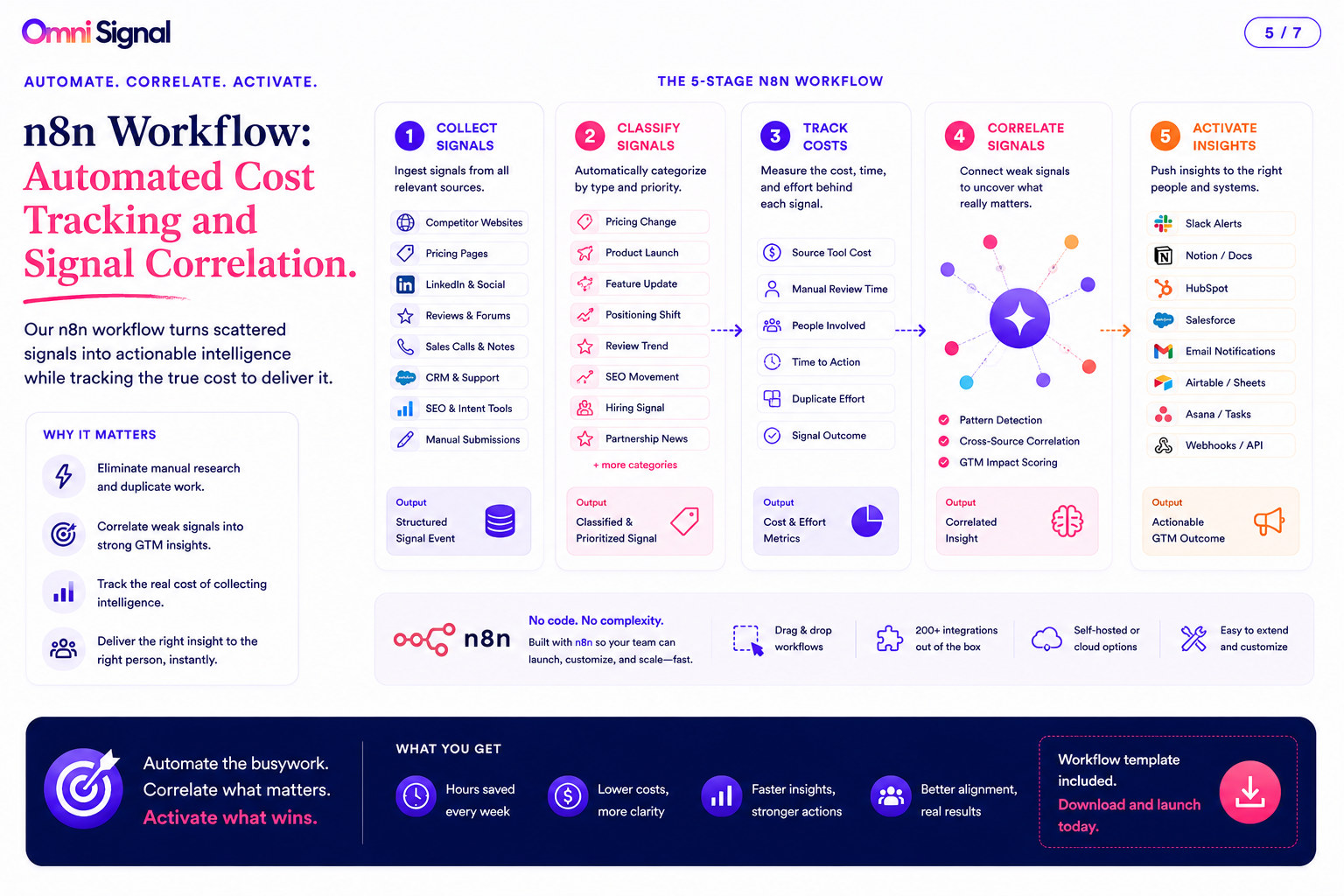
n8n Workflow: Automated Cost Tracking and Signal Correlation
We included an n8n workflow template to help teams automate the first layer of competitive intelligence operations.
The workflow covers:
- Signal collection from competitor pages, content, CRM notes, reviews, Slack, and research tools.
- Signal classification by type: pricing, product update, positioning shift, review trend, SEO movement, customer win, or sales objection.
- Cost tracking to measure manual effort, tool overlap, and response delays.
- Signal correlation to connect weak signals into stronger GTM insights.
- Activation through Slack, Notion, HubSpot, Salesforce, Airtable, battlecards, or content planning tools.
The goal is not just automation.
The goal is faster movement from signal to action.
Implementation Timeline: 30-Day Migration with Zero Downtime
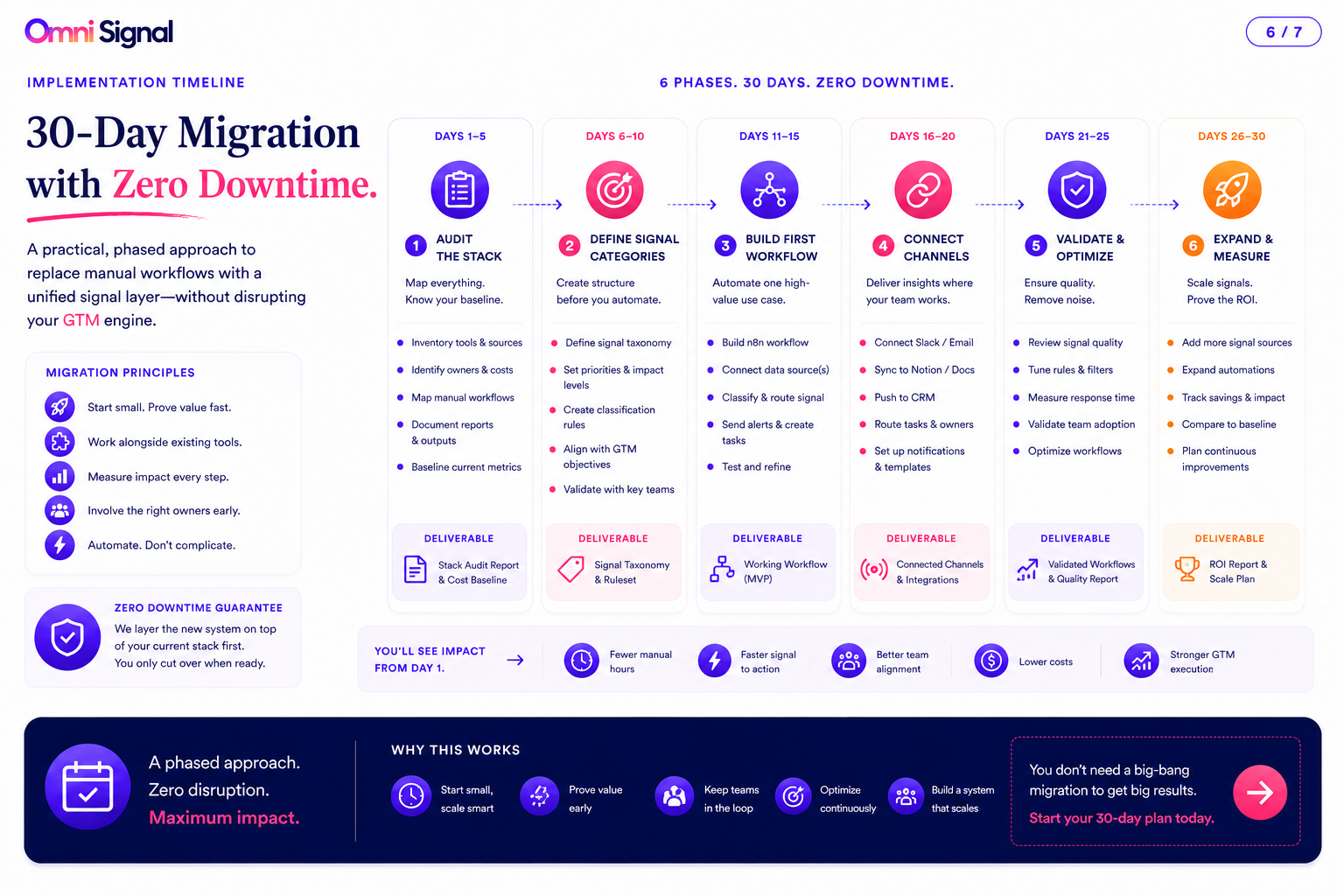
You do not need a full rebuild to start.
A practical 30-day migration looks like this:
Days 1–5: Audit the current stack
Map tools, owners, costs, signal sources, meetings, and manual workflows.
Days 6–10: Define signal categories
Create a taxonomy for pricing changes, product launches, positioning shifts, reviews, SEO movement, objections, and market trends.
Days 11–15: Launch one n8n workflow
Start with one high-value use case, such as competitor page change → classification → Slack alert → battlecard task.
Days 16–20: Connect activation channels
Push outputs into tools your team already uses: Slack, Notion, HubSpot, Salesforce, Airtable, or Google Sheets.
Days 21–25: Validate signal quality
Check relevance, false positives, ownership, and whether sales actually uses the output.
Days 26–30: Expand and measure
Add more signal sources and compare time, cost, and response speed against your baseline.
ROI Validation: How to Measure Intelligence Velocity Gains
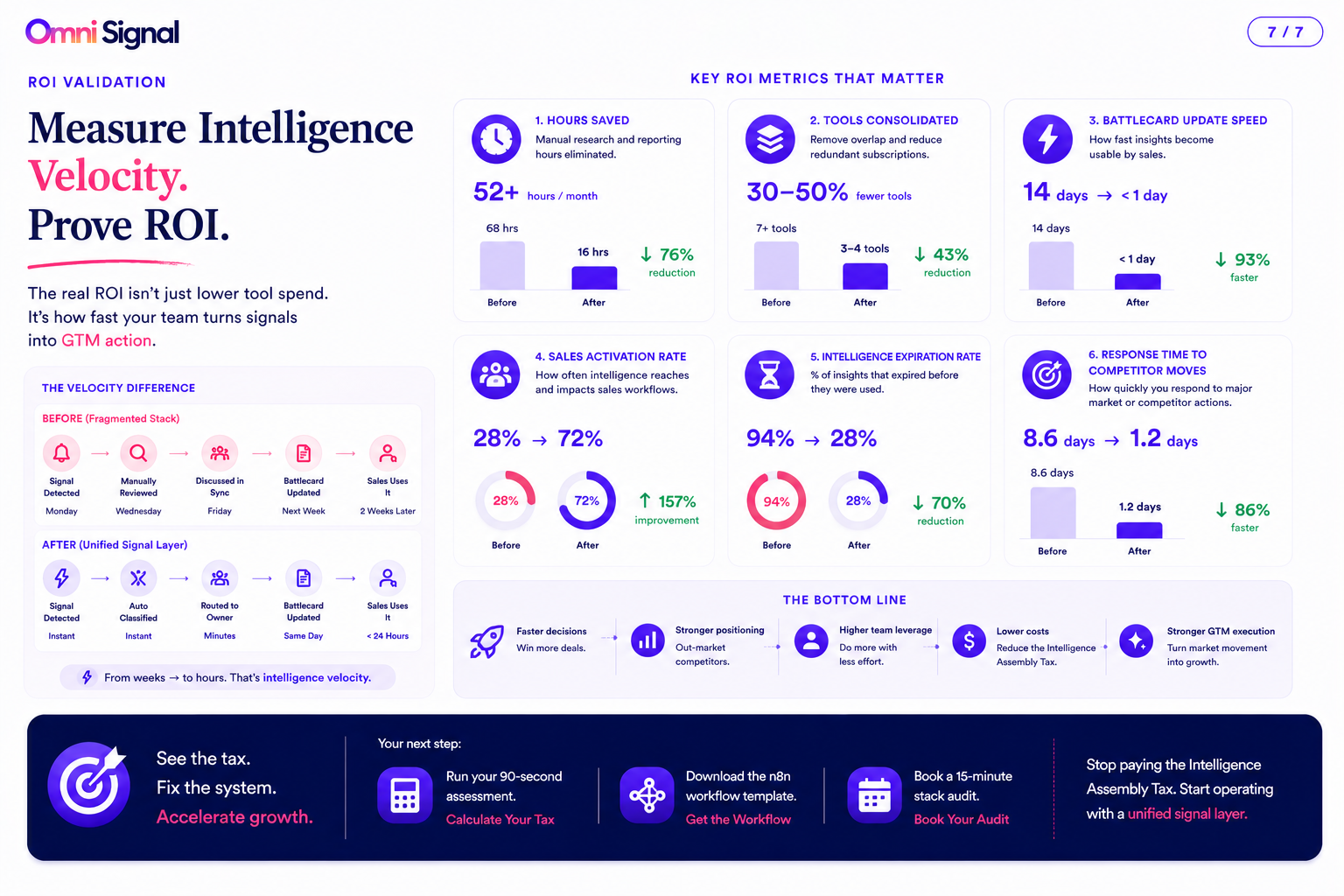
The biggest ROI is not just lower software spend.
It is intelligence velocity.
Measure how fast your team moves from:
Signal → Insight → Action
Key metrics include:
- hours saved per month
- tools consolidated
- battlecard update speed
- sales activation rate
- intelligence expiration rate
- response time to competitor moves
- duplicated research reduced
If a competitor changes pricing today, your sales team should not find out next week.
That gap is where the tax lives.
Final Thought
Competitive intelligence should not be a weekly assembly job.
If your team spends more time collecting and summarizing signals than acting on them, you are paying the Intelligence Assembly Tax.
The solution is not another dashboard.
It is a unified signal layer that turns market movement into sales and marketing action before the insight expires.
Try the calculator: https://www.omnisignal.ai/tax-calculator/
Book a 15-minute stack audit: https://bookings.cloud.microsoft/book/MeetOmniSignal1@quorini.com/?ismsaljsauthenabled