Case Study: How OmniSignal Aligns Two Marketing Teams Around One Winning Content Strategy

Company type
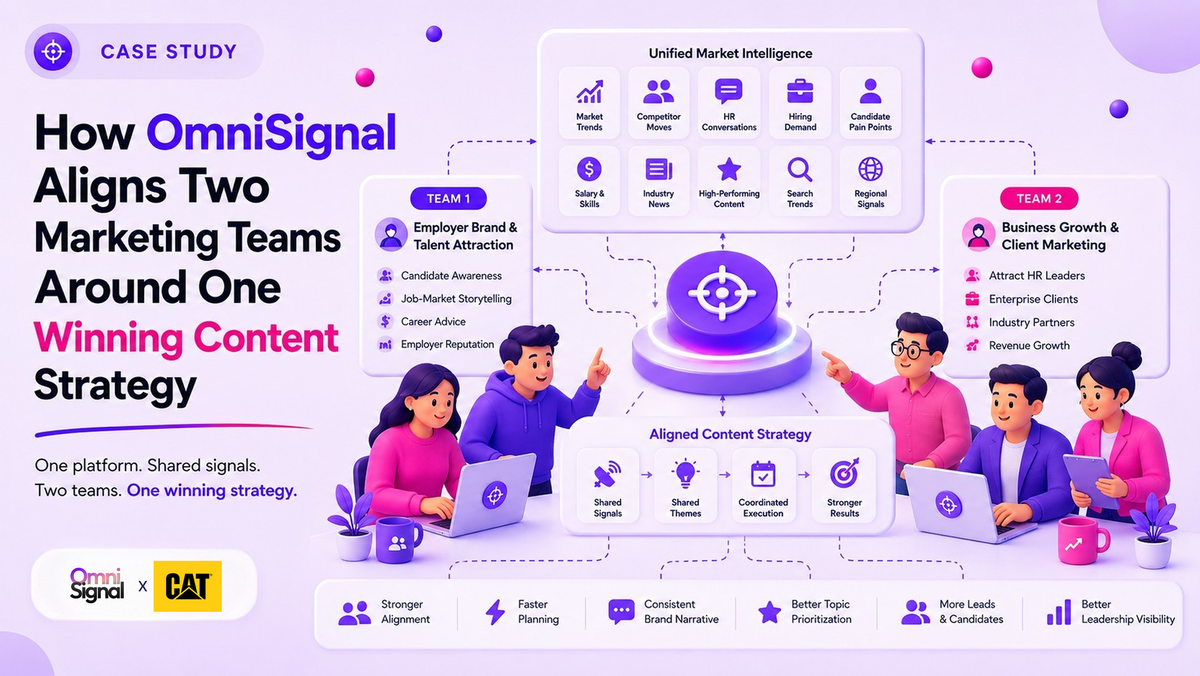
A large HR and recruitment agency similar to Caterpillar’s talent and workforce ecosystem, operating across multiple business units, regions, and employer-brand priorities.
Situation
The agency had two marketing teams working in parallel:
Team 1: Employer Brand & Talent Attraction
Focused on candidate awareness, job-market storytelling, career advice, and employer reputation.
Team 2: Business Growth & Client Marketing
Focused on attracting hiring managers, HR leaders, enterprise clients, and industry partners.
Both teams were producing content, but their strategies were not connected.
The Problem
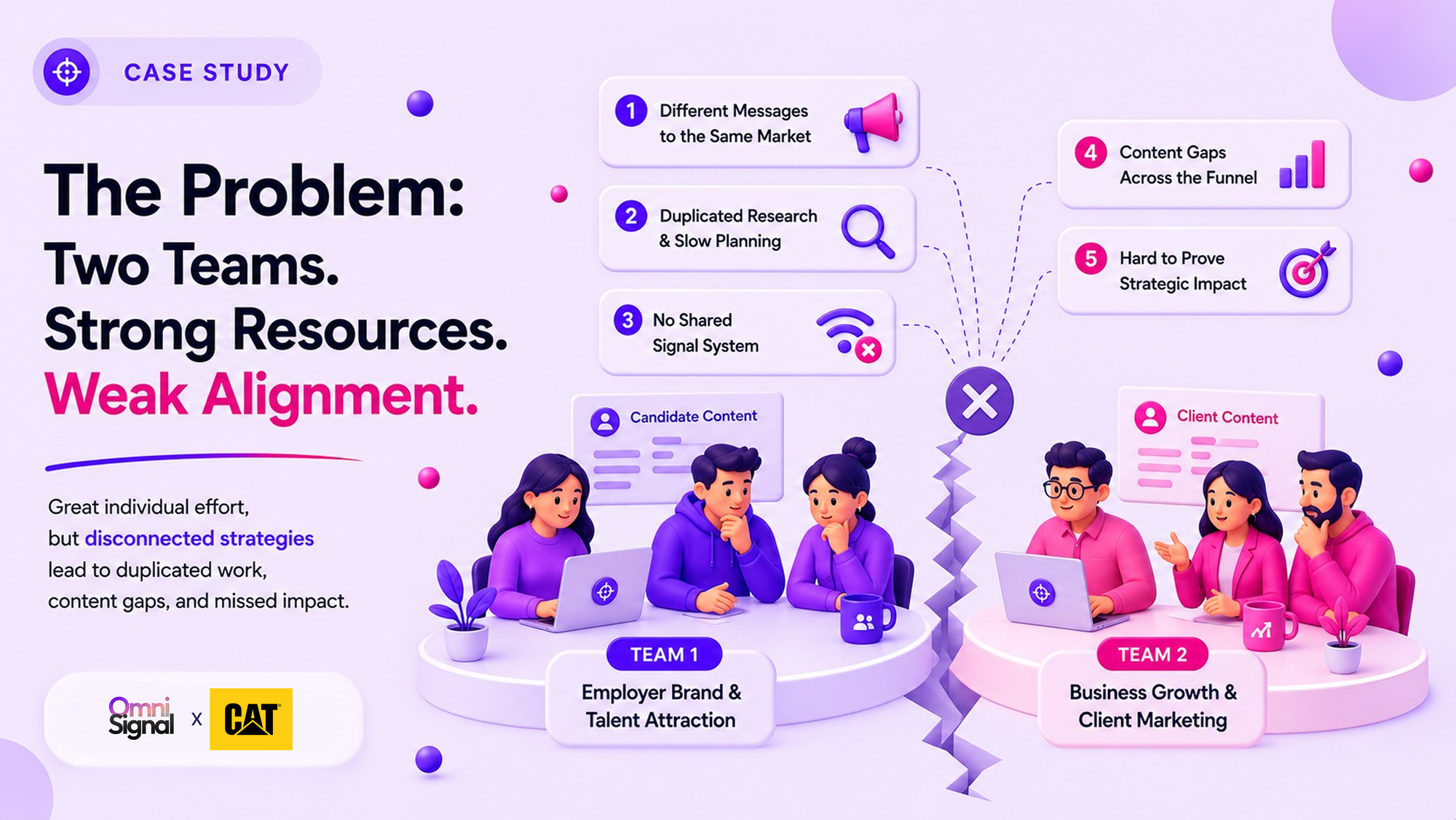
The agency had strong marketing resources, but weak strategic alignment.
Each team had its own calendar, research process, content ideas, and definition of success. As a result, the brand looked active but not coordinated.
Key challenges
1. Different messages to the same market
The candidate-focused team talked about career growth, skills, and workplace culture.
The client-focused team talked about workforce planning, hiring trends, and recruitment efficiency.
Both topics were connected, but the content was not.
2. Duplicated research and slow planning
Both teams separately monitored:
- labor market trends
- competitor content
- hiring demand
- LinkedIn conversations
- candidate pain points
- employer concerns
- industry reports
This created duplicated work and inconsistent conclusions.
3. No shared signal system
The teams reacted to ideas manually: a competitor post, a new report, a client request, or an internal opinion.
There was no central way to understand which market signals mattered most.
4. Content gaps across the funnel
Some topics were overused, while important opportunities were missed.
For example, the agency had many candidate-facing posts about interview tips, but fewer strategic pieces for HR leaders about skills shortages, salary pressure, retention, and workforce planning.
5. Hard to prove strategic impact
Because both teams worked separately, leadership could not easily see how content supported pipeline, brand visibility, lead generation, and candidate acquisition together.
The Solution
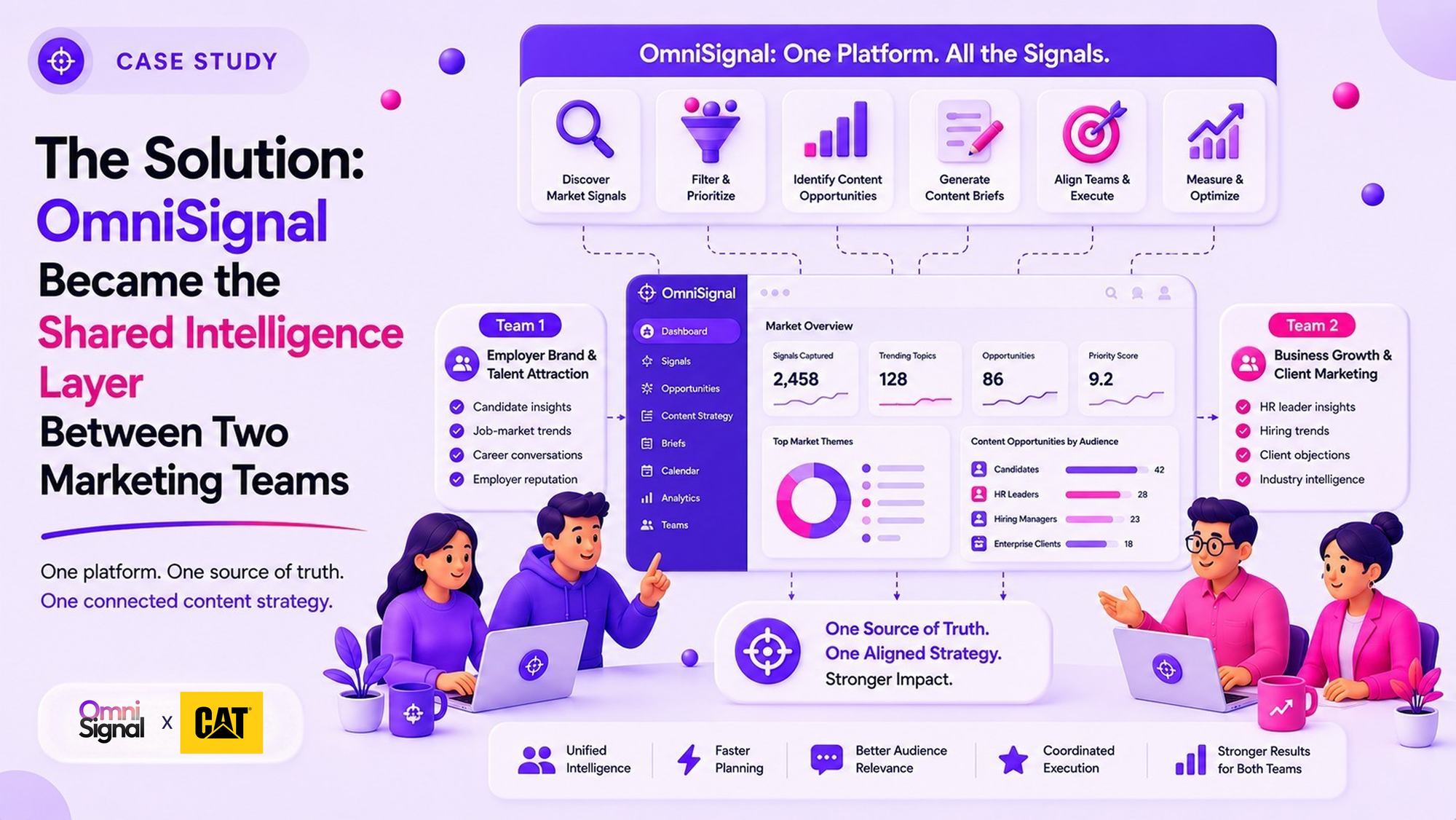
OmniSignal became the shared intelligence layer between the two marketing teams.
Instead of each team building strategy from separate assumptions, OmniSignal collected and structured market signals into one connected content strategy.
How OmniSignal was used
1. Unified market intelligence dashboard
OmniSignal monitored key signals across the HR and recruitment market:
- competitor content moves
- LinkedIn discussions from HR leaders
- candidate pain points
- hiring-market trends
- salary and skills discussions
- industry news
- employer-brand topics
- client objections
- high-performing content formats
- emerging search topics
- regional hiring signals
This gave both teams one source of truth.
2. Shared content strategy by audience
OmniSignal separated content opportunities by audience, but connected them under one strategy.
| Audience | Content Focus |
|---|---|
| Candidates | Career advice, skill development, interview preparation, workplace expectations |
| HR Leaders | Hiring trends, retention, workforce planning, talent shortages |
| Hiring Managers | Role-specific hiring challenges, speed, quality, market benchmarks |
| Enterprise Clients | Strategic talent planning, employer brand, recruitment efficiency |
This helped both teams see where their work connected instead of competing.
3. One aligned content calendar
OmniSignal generated a shared content calendar with clear ownership.
Example:
| Theme | Candidate Team | Client Marketing Team |
|---|---|---|
| Skills shortage | “How to future-proof your career in 2026” | “Why skills-based hiring is becoming a competitive advantage” |
| Salary pressure | “How to negotiate your next offer” | “How salary transparency affects hiring conversion” |
| Workplace flexibility | “What candidates now expect from employers” | “How flexible work impacts retention and hiring speed” |
| AI in recruitment | “How candidates can stand out in AI-screened hiring” | “How HR teams can use AI without damaging candidate experience” |
Instead of two disconnected calendars, the teams created a coordinated market narrative.
4. Signal-based content briefs
For every priority topic, OmniSignal produced a content brief with:
- why the topic matters now
- which audience should be targeted
- what signal triggered the opportunity
- suggested angle
- recommended format
- channel recommendation
- supporting talking points
- competitor gap
- CTA suggestion
This reduced planning time and made content decisions easier to defend.
5. Clear role separation
OmniSignal helped define who owns what.
Employer Brand Team:
Turns market signals into candidate-facing stories.
Client Marketing Team:
Turns the same signals into business-facing thought leadership and lead-generation content.
Leadership:
Uses OmniSignal to review priorities, content performance, and strategic gaps.
The Outcome
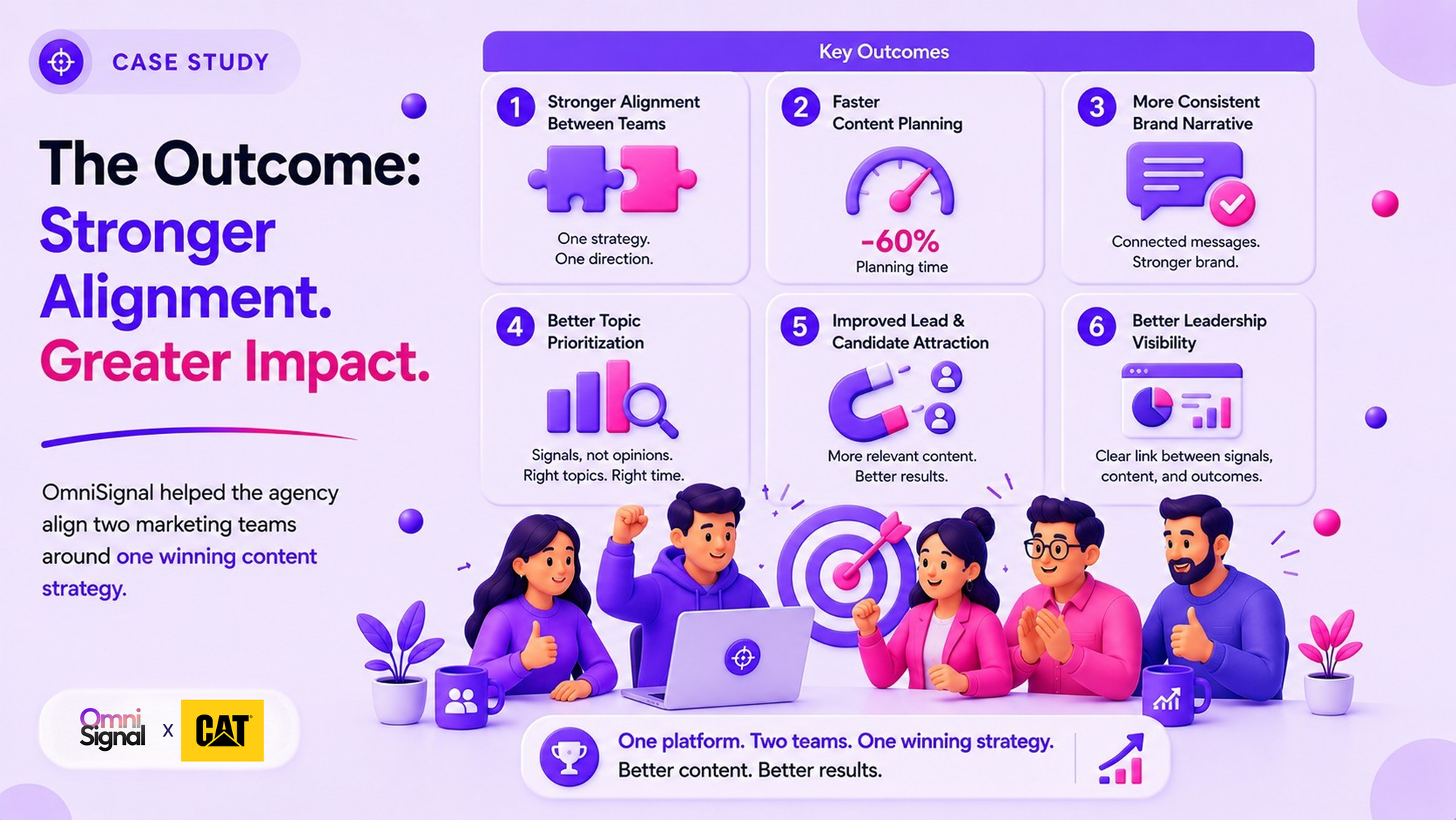
After implementing OmniSignal, the agency moved from fragmented content production to coordinated market positioning.
Key outcomes
1. Stronger alignment between teams
Both marketing teams worked from the same market intelligence, shared themes, and connected campaign priorities.
2. Faster content planning
Research and planning time decreased because OmniSignal replaced manual signal collection with structured briefs and recommendations.
3. More consistent brand narrative
Candidate-facing and client-facing content started supporting the same strategic story instead of sending separate messages.
4. Better topic prioritization
The teams stopped choosing topics based only on opinions or competitor imitation.
They prioritized content based on real market signals.
5. Improved lead and candidate attraction
The agency created content that served both sides of the marketplace:
- candidates understood career opportunities better
- clients saw the agency as a strategic workforce partner
- HR leaders received more relevant insights
- sales teams had stronger content to use in outreach
6. Better leadership visibility
Management could finally see how content themes connected to business priorities, hiring demand, market trends, and audience needs.
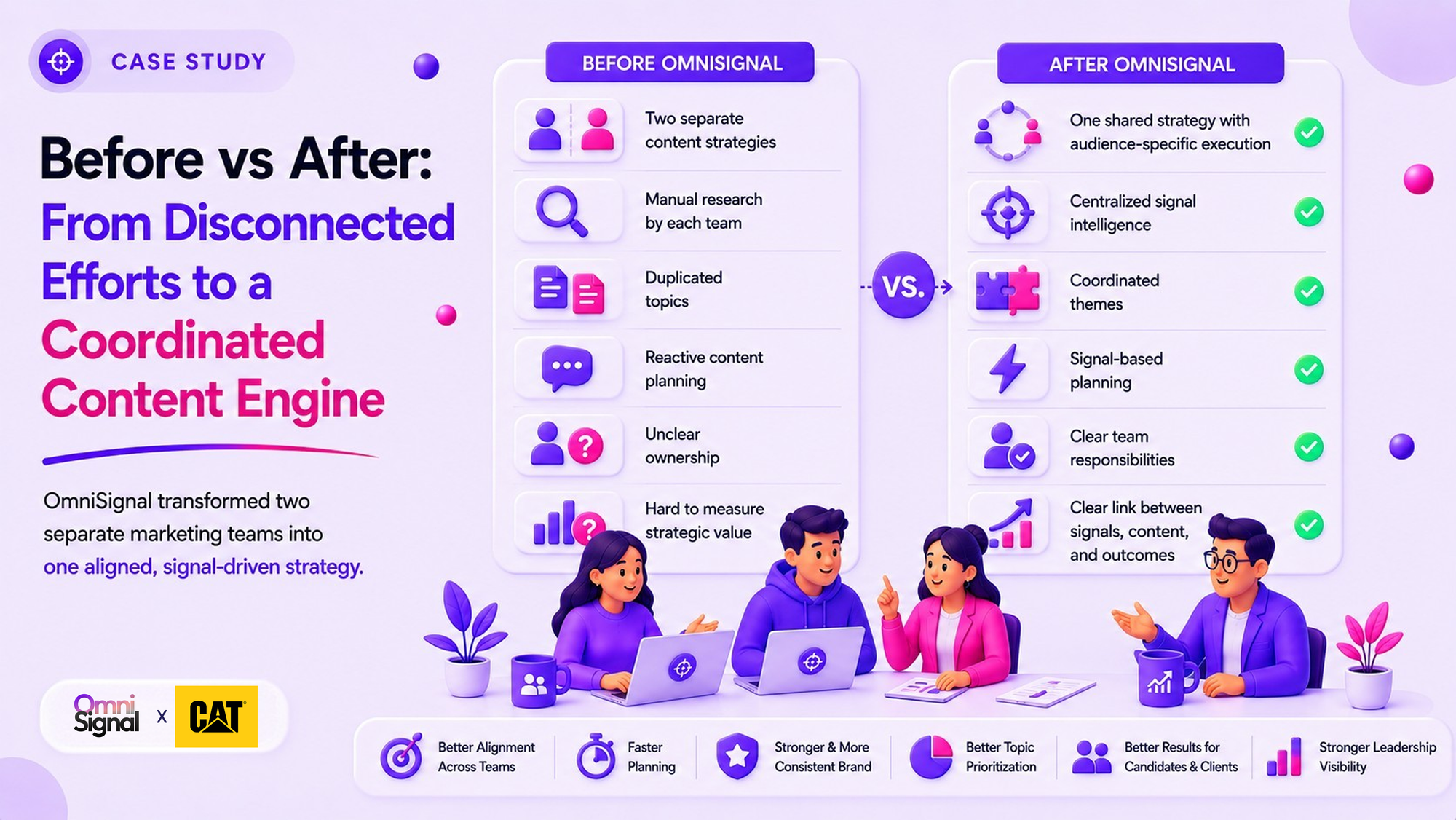
Before vs After
| Before OmniSignal | After OmniSignal |
|---|---|
| Two separate content strategies | One shared strategy with audience-specific execution |
| Manual research by each team | Centralized signal intelligence |
| Duplicated topics | Coordinated themes |
| Reactive content planning | Signal-based planning |
| Unclear ownership | Clear team responsibilities |
| Hard to measure strategic value | Clear link between signals, content, and outcomes |
Final Summary
OmniSignal helped the HR agency align two marketing teams around one strategic content engine.
Instead of creating disconnected content for candidates and clients, both teams started using the same market signals to build a coordinated narrative.
The result was faster planning, stronger positioning, better audience relevance, and a content strategy that supported both talent attraction and business growth.