
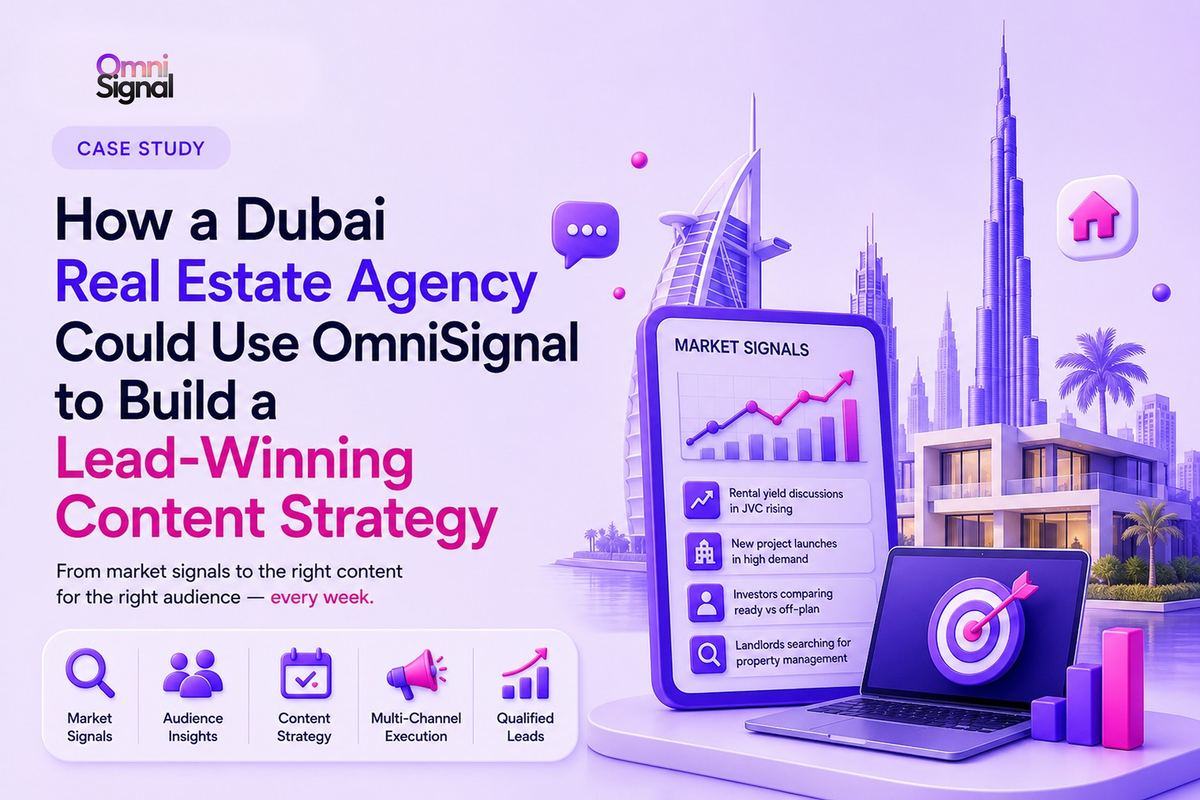
Case Study: How a Dubai Real Estate Agency Could Use OmniSignal to Build a Lead-Winning Content Strategy

Problem
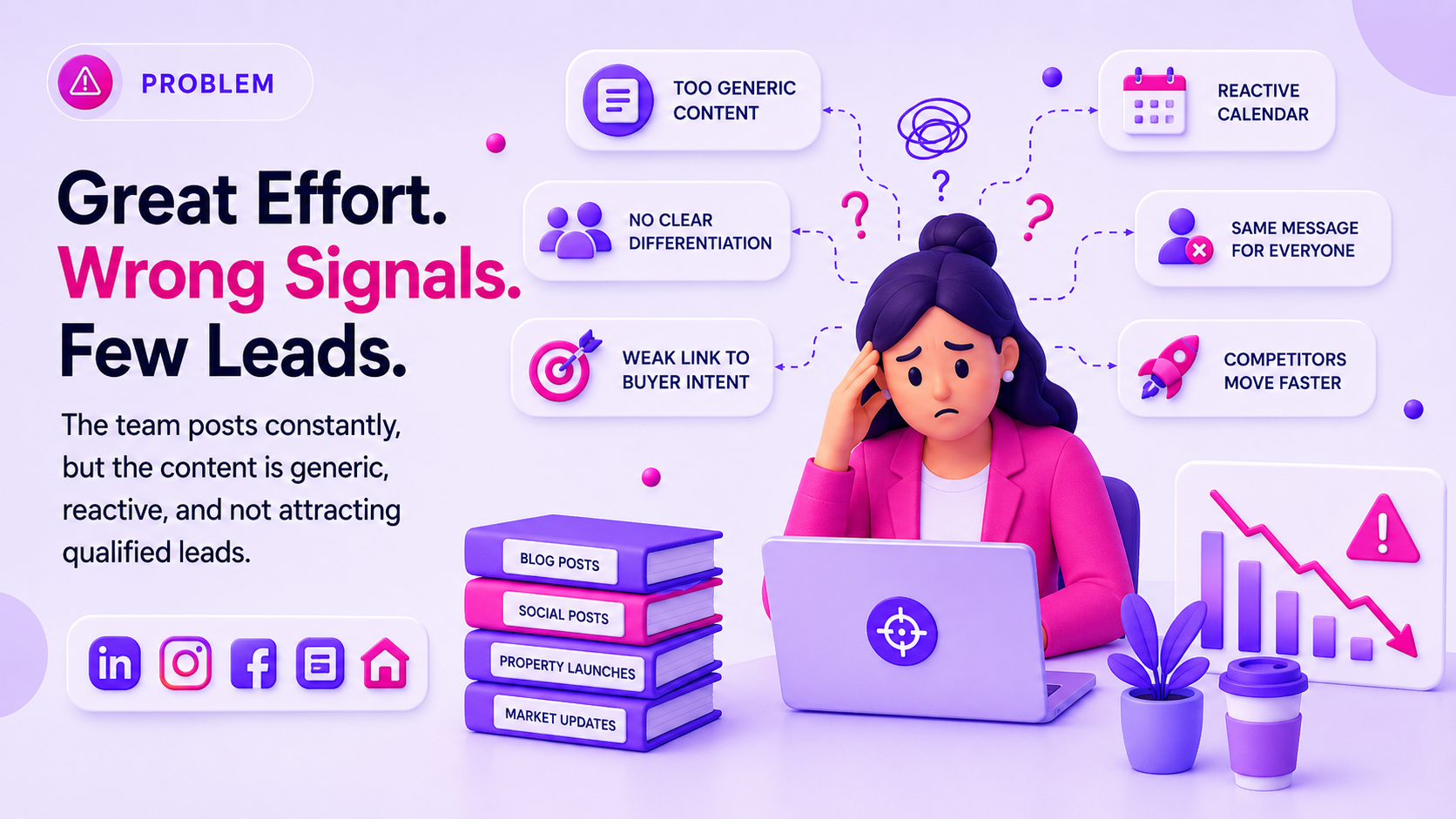
A Dubai real estate agency has a marketing team, but their content strategy is not producing consistent qualified leads.
The team posts regularly across LinkedIn, Instagram, Facebook, blogs, and property platforms, but the content is mostly reactive:
Typical content problems:
- Too many generic posts: “Dubai market is growing”, “Best areas to invest”, “New property launch”
- No clear differentiation from hundreds of other Dubai agencies
- Content calendar driven by internal ideas, not market signals
- Weak connection between content and actual buyer/seller intent
- Agents ask for content, but marketing does not know which property type, audience, or topic to prioritize
- Investors, landlords, tenants, and first-time buyers all receive similar messaging
- Competitors move faster on trending topics: new communities, visa changes, mortgage news, rental yield shifts, developer launches
For a company offering multiple services — sales, leasing, property management, advisory, inspections, and investment support — this creates a major strategy gap. Harbor-like agencies operate in a crowded market where trust, timing, and expertise matter. Harbor itself highlights experience, property asset management, and fact-based analysis as part of its positioning. (Harbor Dubai)
The core issue:
The marketing team is creating content, but not from the right signals.
They do not have a clear system to answer:
What should we say this week that will attract serious property buyers, sellers, landlords, and investors?
Solution
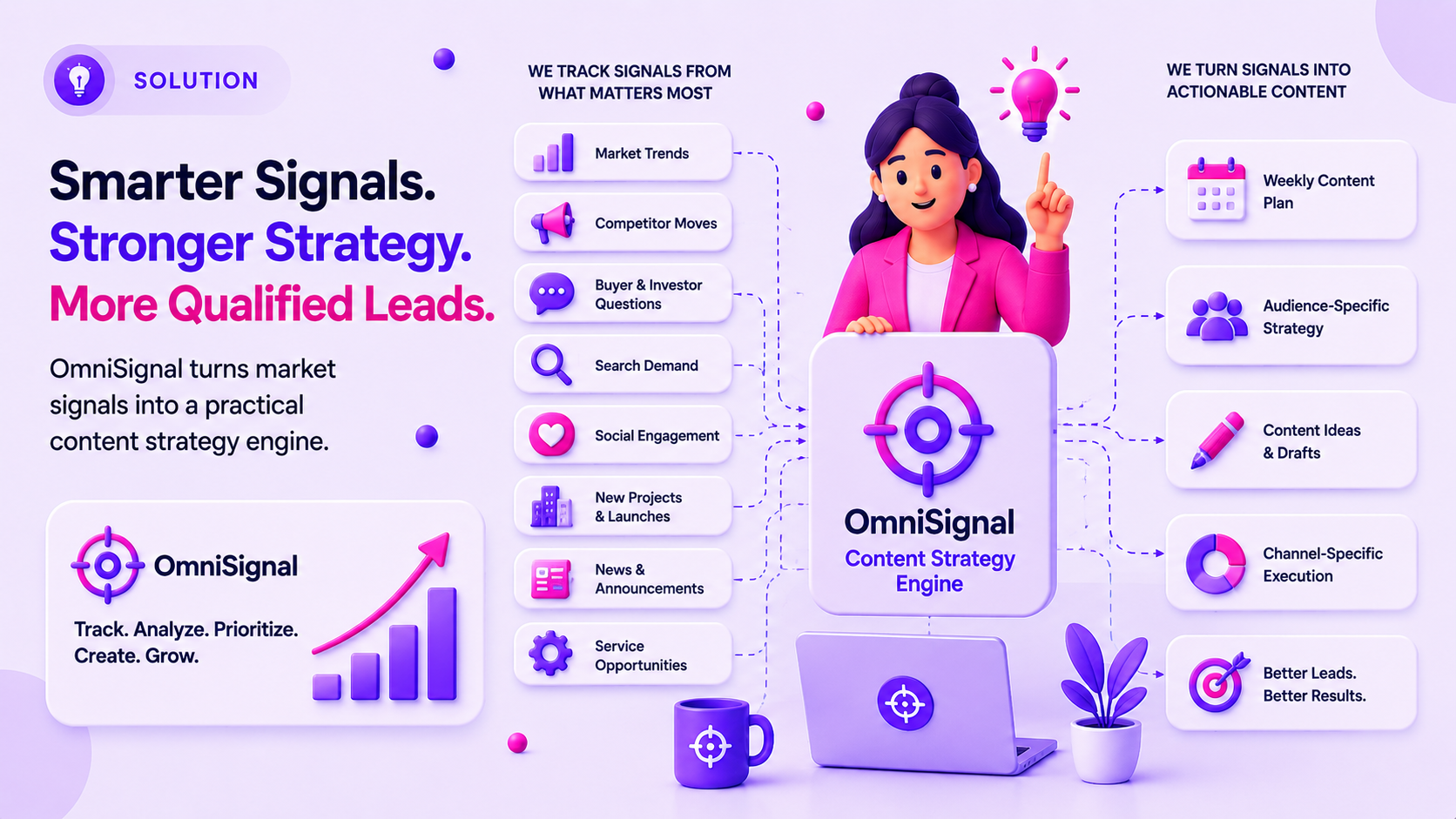
OmniSignal gives the marketing team a signal-driven content strategy engine.
Instead of starting with “what should we post?”, the team starts with:
What is changing in the market, and which audience should care?
OmniSignal tracks and organizes signals from multiple areas:
- Competitor content and positioning
- Dubai real estate market trends
- New project launches
- Buyer and investor questions
- Search demand
- Social media engagement patterns
- Developer announcements
- Rental yield discussions
- Property management pain points
- Market news
- LinkedIn and Instagram topic performance
- Customer objections and FAQs
- Service-specific opportunities: sales, leasing, property management, advisory, inspection
Then OmniSignal turns those signals into a practical content system.
How the workflow looks
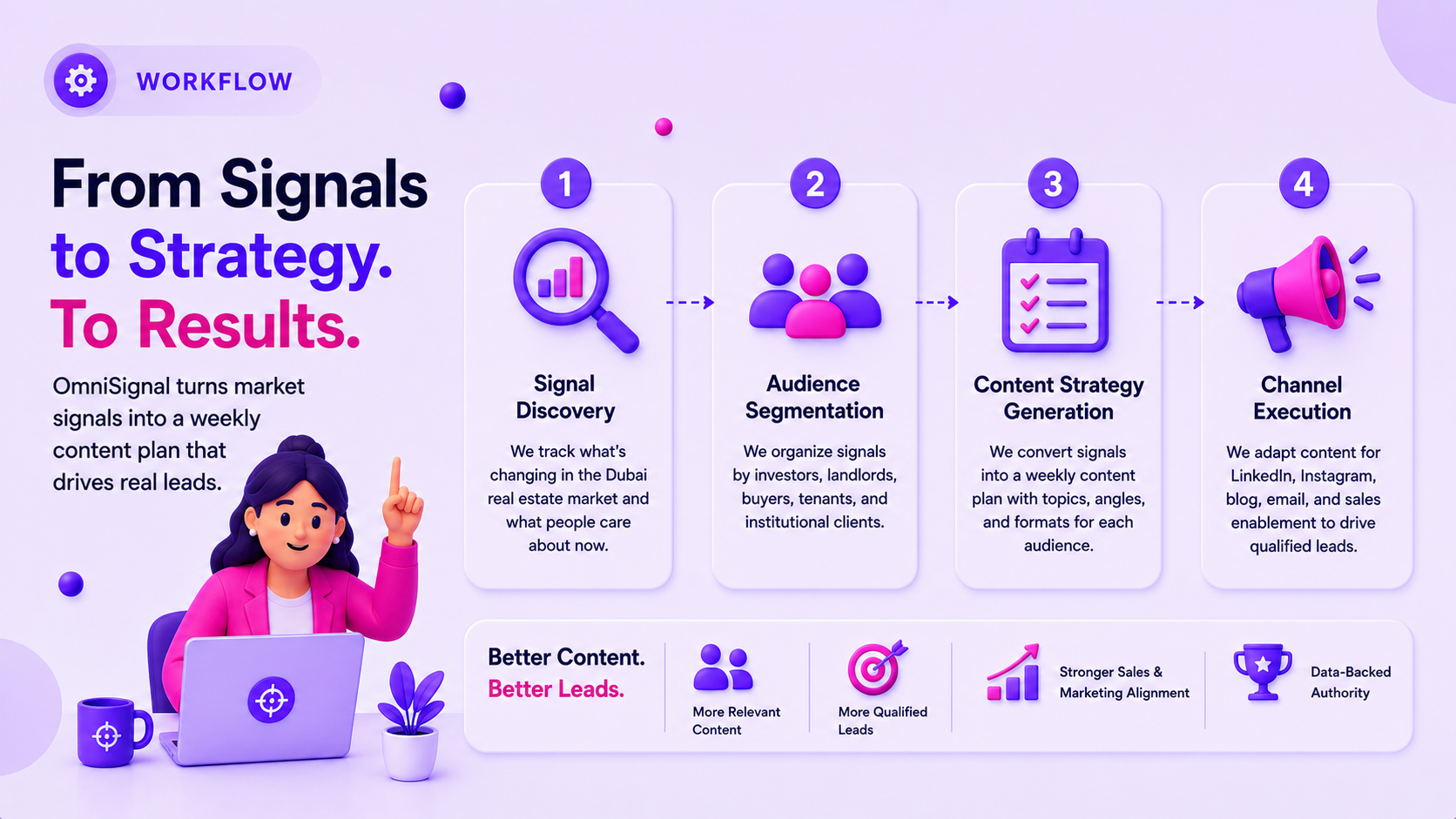
1. Signal discovery
OmniSignal identifies what is gaining attention in the market.
Example signals:
- More investors asking about rental yield in specific Dubai communities
- Competitors pushing “off-plan investment” content
- Landlords searching for property management support
- Buyers comparing ready vs off-plan properties
- New residents asking about renting vs buying
- Increased discussion around service charges, handover delays, and property inspections
2. Audience segmentation
The content strategy is split by audience instead of using one generic calendar.
Investors
Need ROI, rental yield, risk, exit strategy, developer credibility.
Landlords
Need occupancy, tenant quality, maintenance, property management, net rental return.
End-users
Need lifestyle, schools, commute, community comparison, buying process.
Tenants
Need rental trends, negotiation tips, area guides, documentation.
Institutional clients
Need portfolio advisory, asset performance, market intelligence, risk control.
3. Content strategy generation
OmniSignal converts signals into a weekly content plan.
Example content pillars:
Market Intelligence
“Dubai Marina vs JVC vs Business Bay: where rental demand is shifting”
Investor Education
“Why high advertised ROI does not always mean high net return”
Landlord Pain Points
“5 signs your Dubai property is under-managed”
Buyer Trust Content
“Ready property vs off-plan: which makes more sense in 2026?”
Authority Content
“What serious investors should check before buying a Dubai apartment”
Lead Capture Content
“Send us your property details and we’ll estimate your rental potential”
4. Channel-specific execution
OmniSignal adapts each idea to the right format.
LinkedIn: expert posts, market breakdowns, investor insights
Instagram: short reels, carousels, area comparisons, myth-busting
Blog/SEO: long-form guides for high-intent search traffic
Email: segmented campaigns for landlords, investors, buyers
Sales enablement: agent talking points, objection handling, WhatsApp scripts
This helps the marketing team stop creating isolated posts and start building a connected acquisition system.
Outcome
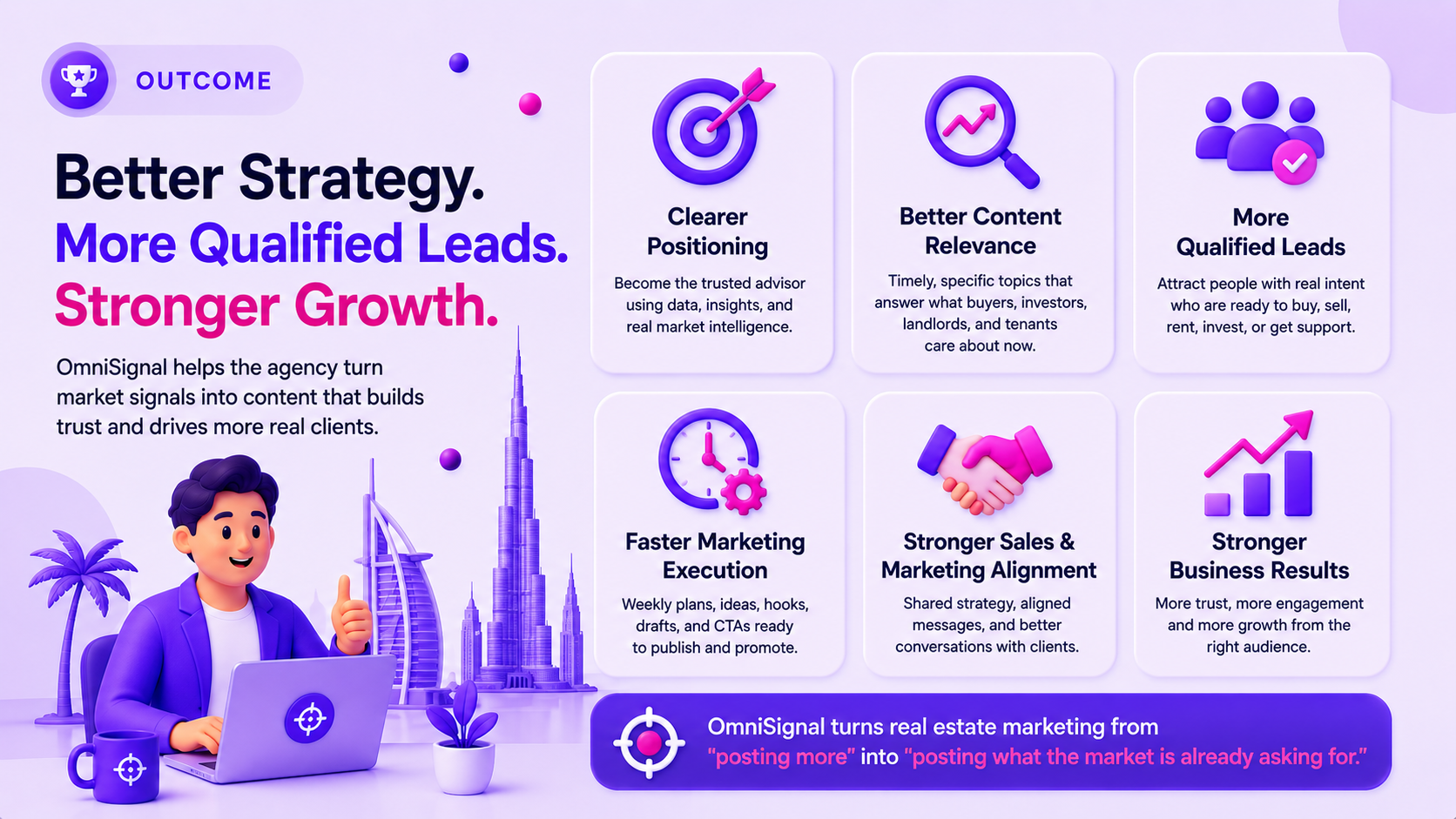
After using OmniSignal, the agency’s marketing team moves from random content production to a structured market-intelligence workflow.
Main business outcomes
1. Clearer positioning
The agency no longer sounds like every other real estate company.
Instead of generic property promotion, it becomes a trusted advisor using market data, buyer signals, and investment logic.
This fits especially well for Harbor-like agencies that already position around fact-based recommendations, asset management, and professional advisory. (Harbor Dubai)
2. Better content relevance
The team can see which topics matter now.
For example, instead of posting:
“Top areas to invest in Dubai”
They post:
“Why landlords in JVC may need to rethink rental pricing this quarter”
Or:
“The hidden cost that first-time Dubai investors often miss”
This creates content that feels timely, specific, and useful.
3. More qualified leads
The content starts attracting people with real intent:
- Landlords considering property management
- Investors comparing communities
- Buyers looking for advisory
- Sellers trying to understand timing
- Tenants preparing for relocation
- Institutional clients evaluating portfolio strategy
The goal is not just more impressions. The goal is more conversations with people who have a real property need.
4. Faster marketing execution
The marketing team no longer spends hours debating what to post.
OmniSignal gives them:
- Weekly content calendar
- Topic rationale
- Audience fit
- Channel format
- Suggested hooks
- Drafts
- CTAs
- Repurposing ideas
- Sales follow-up angles
This reduces research time and gives marketers, agents, and leadership one shared direction.
5. Stronger sales and marketing alignment
Agents can finally see why specific content is being created.
For example:
Signal: landlords are worried about vacancy and lower net returns
Content: “Why your Dubai property may be earning less than it should”
CTA: “Request a rental performance review”
Sales angle: property management audit
Marketing creates the content. Sales uses it in conversations. Leadership sees the strategic logic.
Before vs After
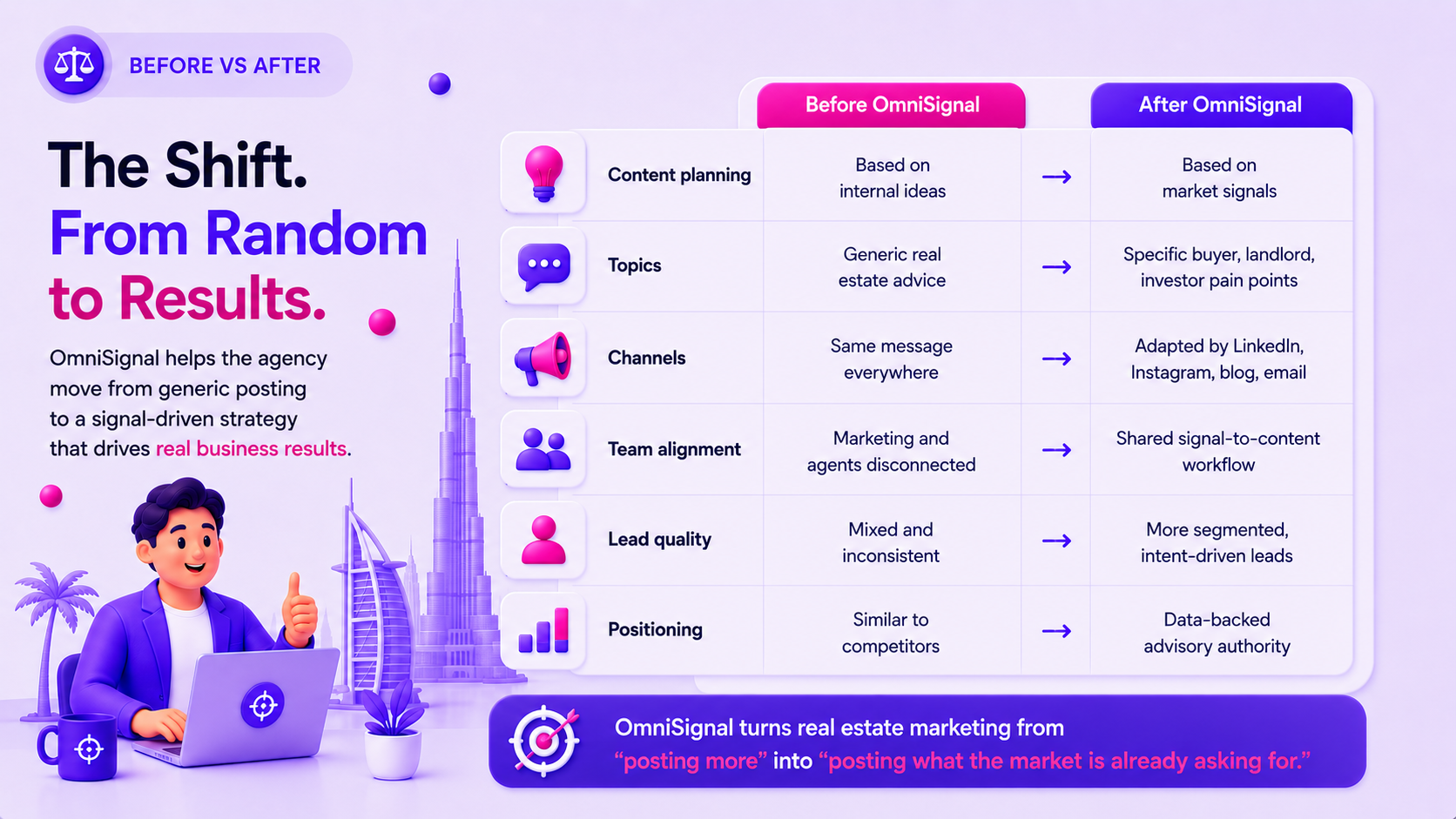
| Area | Before OmniSignal | After OmniSignal |
|---|---|---|
| Content planning | Based on internal ideas | Based on market signals |
| Topics | Generic real estate advice | Specific buyer, landlord, investor pain points |
| Channels | Same message everywhere | Adapted by LinkedIn, Instagram, blog, email |
| Team alignment | Marketing and agents disconnected | Shared signal-to-content workflow |
| Lead quality | Mixed and inconsistent | More segmented, intent-driven leads |
| Positioning | Similar to competitors | Data-backed advisory authority |
Final Case Study Summary
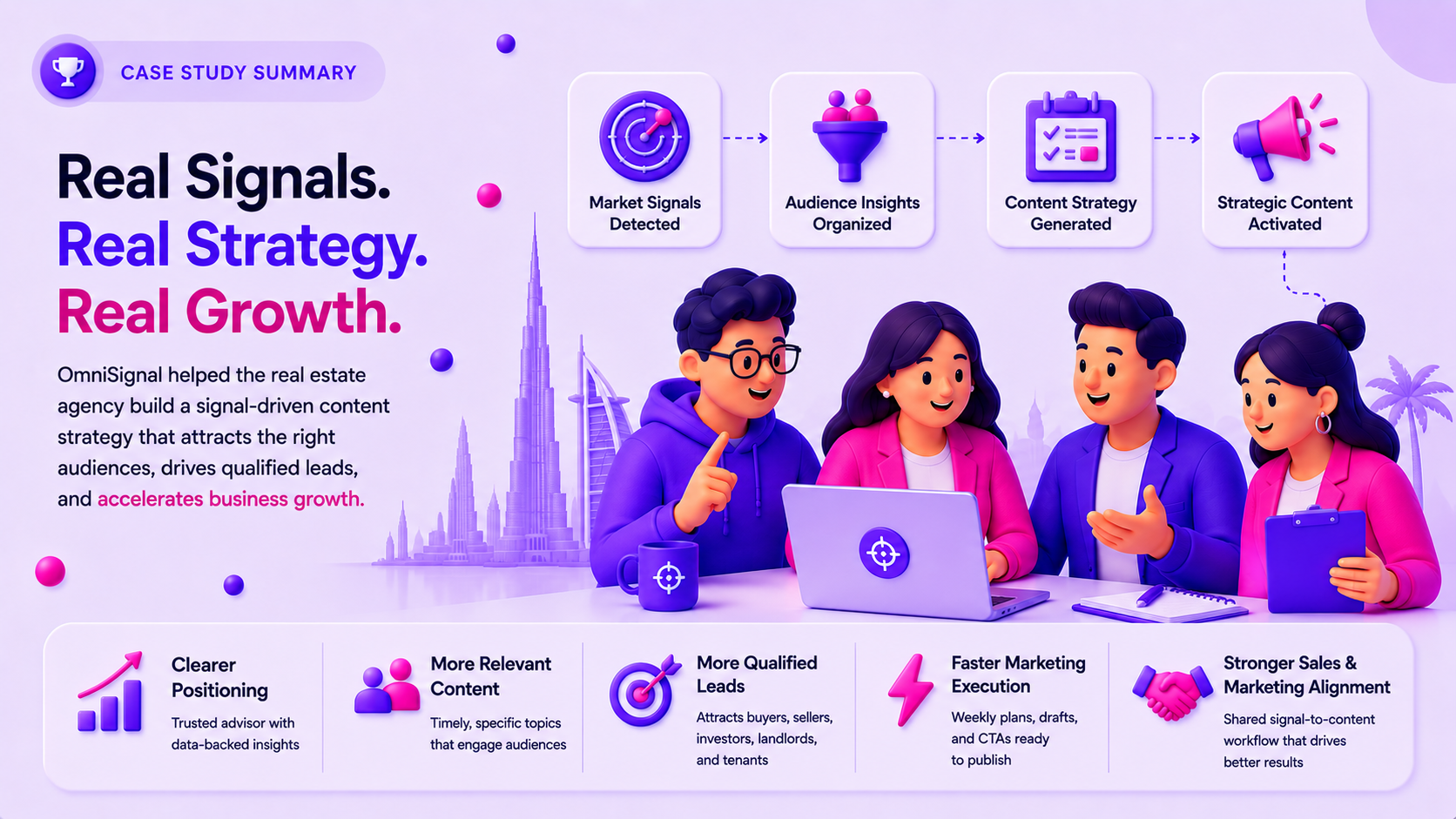
A Dubai real estate agency with a marketing team was struggling to build a content strategy that consistently attracted qualified leads. Their content was active, but not strategic enough: too generic, too reactive, and too disconnected from real buyer, landlord, and investor signals.
OmniSignal helped the team turn market noise into a structured content strategy.
By tracking competitor moves, market trends, audience questions, property pain points, and channel performance, OmniSignal created a weekly signal-driven content plan for each audience segment.
The result was a clearer positioning, more relevant content, faster execution, better sales alignment, and stronger lead generation from people actively interested in buying, selling, renting, investing, or managing property in Dubai.
OmniSignal turns real estate marketing from “posting more” into “posting what the market is already asking for.”