Case Study: How an Agency-Style Marketing Team Uses OmniSignal to Turn Market Noise Into Winning Content


Company Profile
A creative digital consultancy like Factory39 works at the intersection of brand strategy, marketing, design, UX, software, and product growth. Their own positioning is built around engineering brands and digital products to drive business growth, with services covering brand and marketing strategy, branding, UX/UI, software consultancy, and software development.
For a team like this, content is not just “marketing output.” It supports client positioning, campaign strategy, brand authority, sales enablement, and product launches.
The team usually includes:
- Marketing strategists
- Researchers
- Content creators
- Designers
- Video producers
- Brand strategists
- Account/project managers
- Founders or senior partners
The challenge is that each role needs market intelligence, but everyone uses it differently.

The Problem
The team had creativity, but market intelligence was fragmented
Before OmniSignal, the agency team relied on a mix of manual research, competitor tracking, social listening, trend reports, client calls, LinkedIn scrolling, newsletters, and ad-hoc Google searches.
The problem was not a lack of information.
The problem was that information was everywhere.
Researchers collected competitor insights.
Strategists looked for positioning gaps.
Content creators searched for hooks and angles.
Video producers needed timely narratives.
Account managers needed quick explanations for clients.
But there was no single system connecting all of this into a clear content strategy.
Research slowed down execution
Every new campaign started with the same cycle:
- Check competitors.
- Review recent industry news.
- Look at LinkedIn and top voices.
- Find what customers are talking about.
- Analyze content formats that are performing.
- Turn findings into campaign ideas.
- Align the team.
- Produce content.
By the time the team finished research, the market had often already moved.
This created several operational issues:
1. Campaign ideas were based on incomplete signals
One strategist might find a strong market trend.
Another might find a competitor launch.
A content creator might discover a viral narrative.
But these insights lived in separate docs, Slack messages, browser tabs, or personal notes.
The team lacked a shared signal layer.
2. Content production started too late
Video and design teams often received briefs after the research phase was already finished. This compressed production timelines and reduced creative quality.
Instead of having time to develop strong narratives, the production team had to rush assets for campaigns that were already time-sensitive.
3. Client strategy depended too much on manual expertise
Senior strategists carried a lot of context in their heads. This worked when the team was small, but it created bottlenecks.
Junior marketers could produce content, but they needed more guidance on:
- What market signals matter
- Which competitors to track
- Which narratives are gaining attention
- Which content angles are worth testing
- Which formats fit the client’s category
4. Reporting focused on outputs, not intelligence
The team could show clients deliverables: posts, videos, landing pages, campaigns, brand assets.
But it was harder to show the intelligence behind the work:
- Why this topic?
- Why this angle?
- Why now?
- Why this format?
- Why this positioning?
For a strategy-first agency, this was a missed opportunity.
The Solution
OmniSignal became the agency’s market intelligence engine
The team used OmniSignal to automate signal discovery across the market and turn it into structured content opportunities.
Instead of starting every campaign from zero, OmniSignal continuously monitored relevant signals such as:
- Competitor content
- Market trends
- Industry news
- Customer pain points
- Top voices
- Winning content formats
- Category narratives
- Product launches
- Pricing changes
- Social conversations
- Search demand
- Brand positioning shifts
This gave the team a live view of what was happening in the market and how it could be turned into content.
How the team used OmniSignal
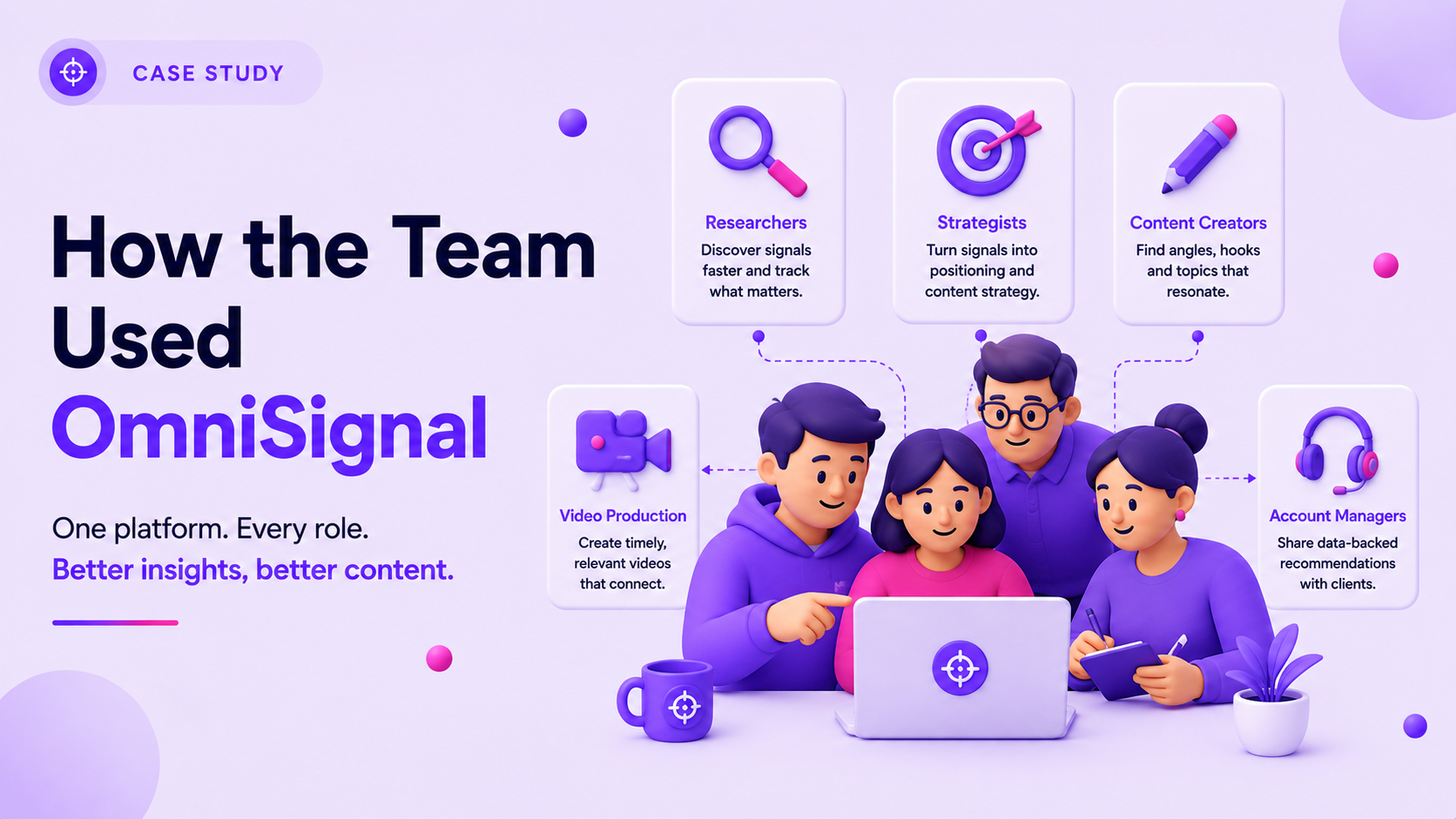
1. Researchers used OmniSignal to replace manual market scanning
Before OmniSignal, researchers spent hours gathering inputs from multiple sources.
With OmniSignal, they could start from a structured signal feed showing:
- What competitors were publishing
- Which topics were gaining traction
- Which market narratives were emerging
- Which customer problems appeared repeatedly
- Which industry events created content opportunities
This changed the role of research from “collecting information” to “validating and prioritizing opportunities.”
2. Strategists used OmniSignal to build sharper positioning
For brand and marketing strategists, OmniSignal helped identify where clients could own a distinct point of view.
Instead of generic messaging like:
“We help companies grow faster.”
The team could build market-backed positioning around specific gaps:
“Your category is talking about AI automation, but no one is addressing trust, implementation risk, or operational readiness. This is the opening.”
OmniSignal helped strategists move from opinion-led strategy to signal-led strategy.
3. Content creators used OmniSignal to generate stronger angles
Writers and social media managers used OmniSignal to turn market signals into content ideas.
For example:
Signal: Competitors are all posting about AI productivity.
Insight: The market is saturated with generic “save time” messaging.
Content angle: “AI does not save time unless your workflow is ready for it.”
Format: LinkedIn carousel, founder post, short video script, blog section.
This gave creators better raw material and reduced the blank-page problem.
4. Video production used OmniSignal to plan timely narratives
For video teams, timing matters.
OmniSignal helped identify fast-moving topics that deserved visual treatment:
- Explainer videos
- Founder POV videos
- Short-form social clips
- Campaign teasers
- Product launch narratives
- Client thought-leadership videos
Instead of receiving vague requests like “make a video about AI,” the production team received clearer briefs:
“Create a 30-second video around the hidden cost of slow market research. Use the competitor launch trend as the trigger and position the client as the faster alternative.”
5. Account managers used OmniSignal to improve client communication
Account managers used OmniSignal reports to explain why the team recommended specific campaigns.
This made client conversations stronger because recommendations were connected to visible market signals.
Instead of saying:
“We think this topic would work well.”
They could say:
“We’re seeing three competitors shift messaging toward operational efficiency, while customer discussions are moving toward cost reduction. This campaign gives you a stronger position before the category becomes crowded.”
The Workflow
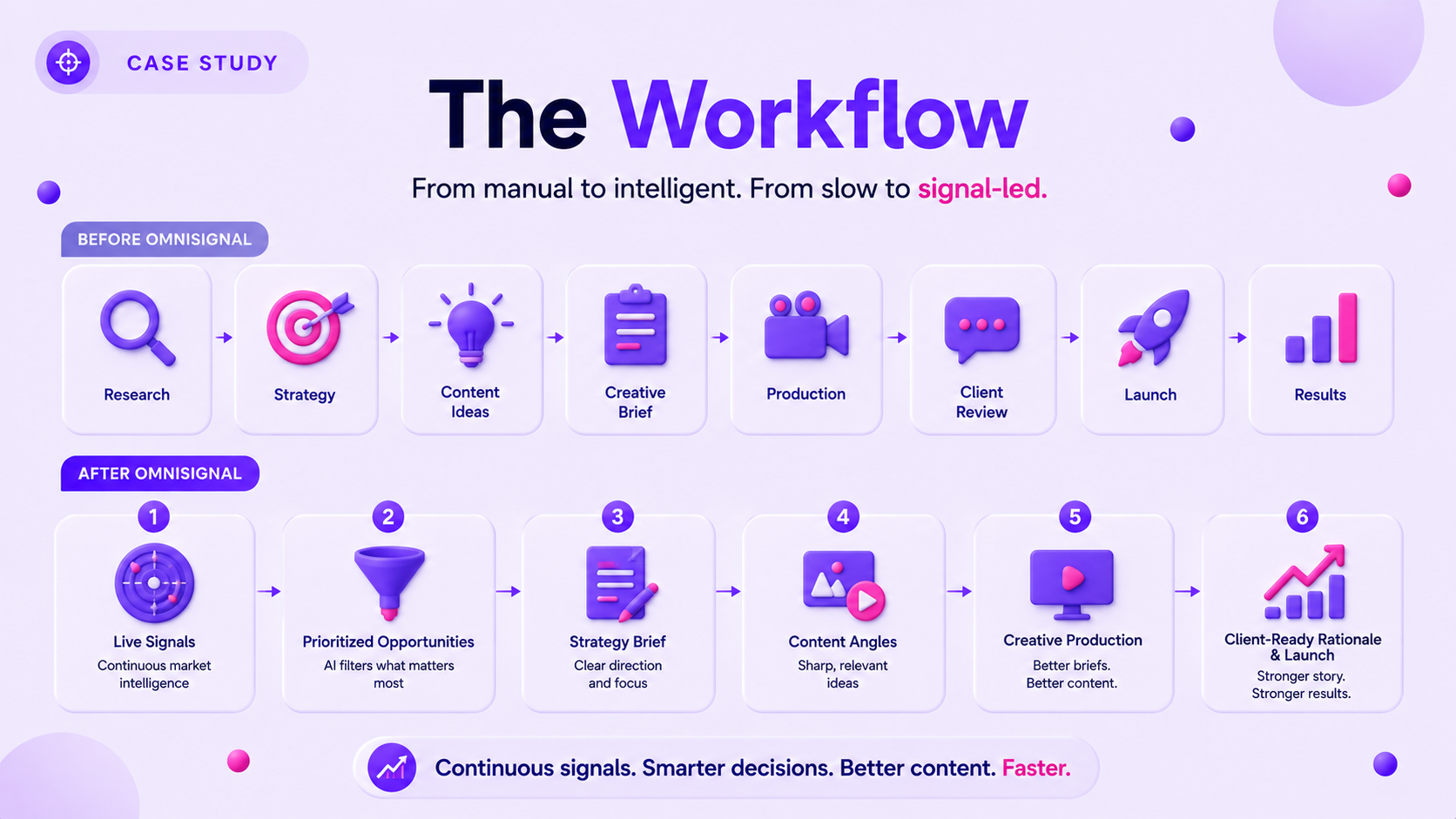
Before OmniSignal
Research → Strategy → Content ideas → Creative brief → Production → Client review → Launch
This process was slow, linear, and dependent on manual synthesis.
After OmniSignal
Live signals → Prioritized opportunities → Strategy brief → Content angles → Creative production → Client-ready rationale → Launch
The team moved from campaign-by-campaign research to continuous market intelligence.
Example Campaign
Client Context
A B2B SaaS client wanted to launch a new positioning campaign around operational efficiency.
OmniSignal Findings
OmniSignal detected that:
- Competitors were publishing more content around AI productivity.
- Most messaging was generic and focused on “saving time.”
- Customer conversations were shifting toward cost control and team efficiency.
- Top voices were discussing the hidden complexity of AI implementation.
- Video posts and short tactical breakdowns were outperforming generic thought-leadership posts.
Strategic Insight
The team identified a stronger narrative:
“AI does not create efficiency by itself. Teams need better signal detection, clearer workflows, and faster execution.”
Content System Created
The agency built a campaign around this narrative:
- Founder LinkedIn post
- Blog article
- Short video script
- Carousel
- Landing page section
- Sales enablement one-pager
- Client newsletter
- Paid ad concepts
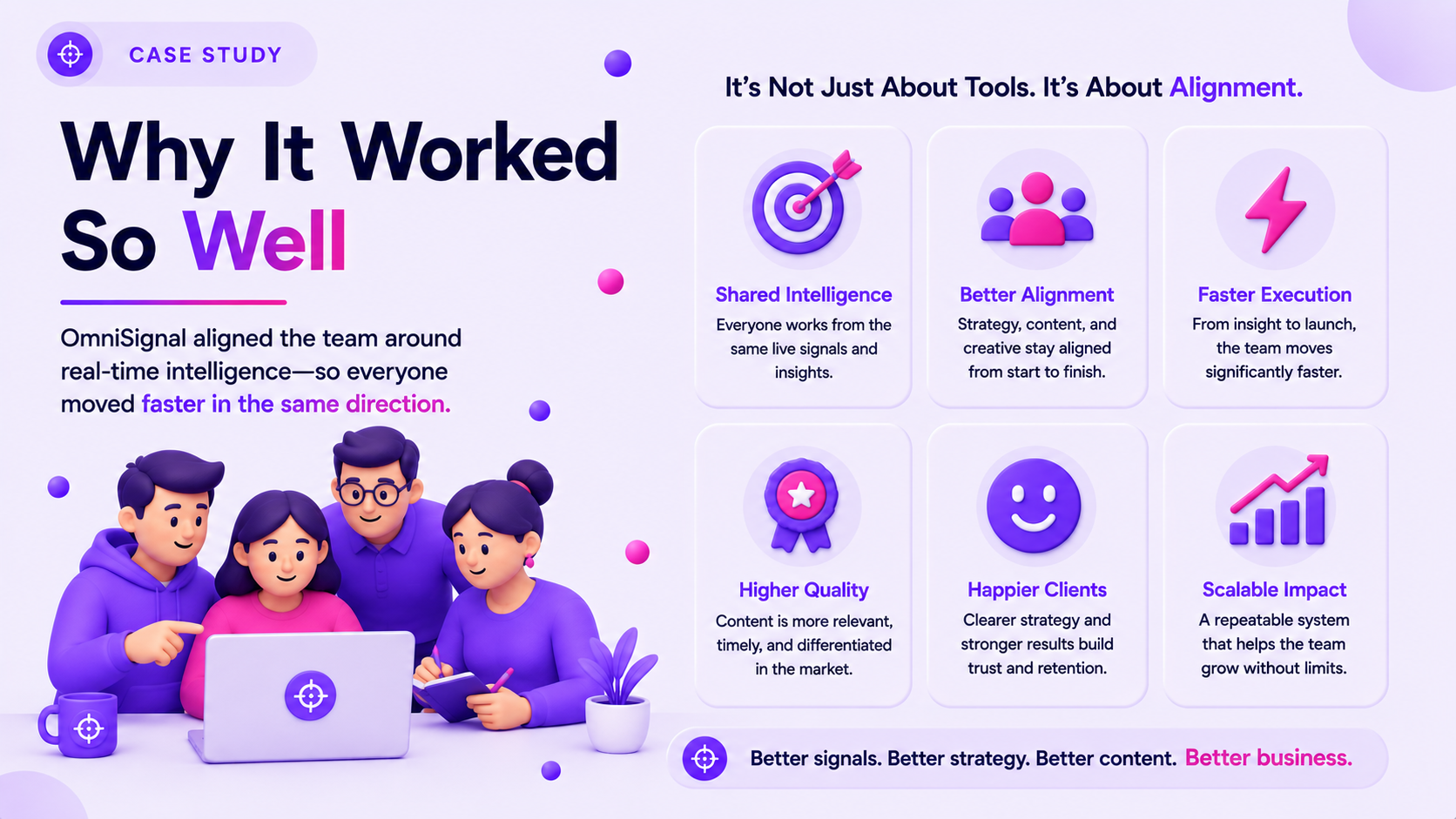
Why It Worked
The campaign was not based on a random creative idea.
It was built from live market movement.
The team could show the client exactly why the campaign mattered now.
The Outcome
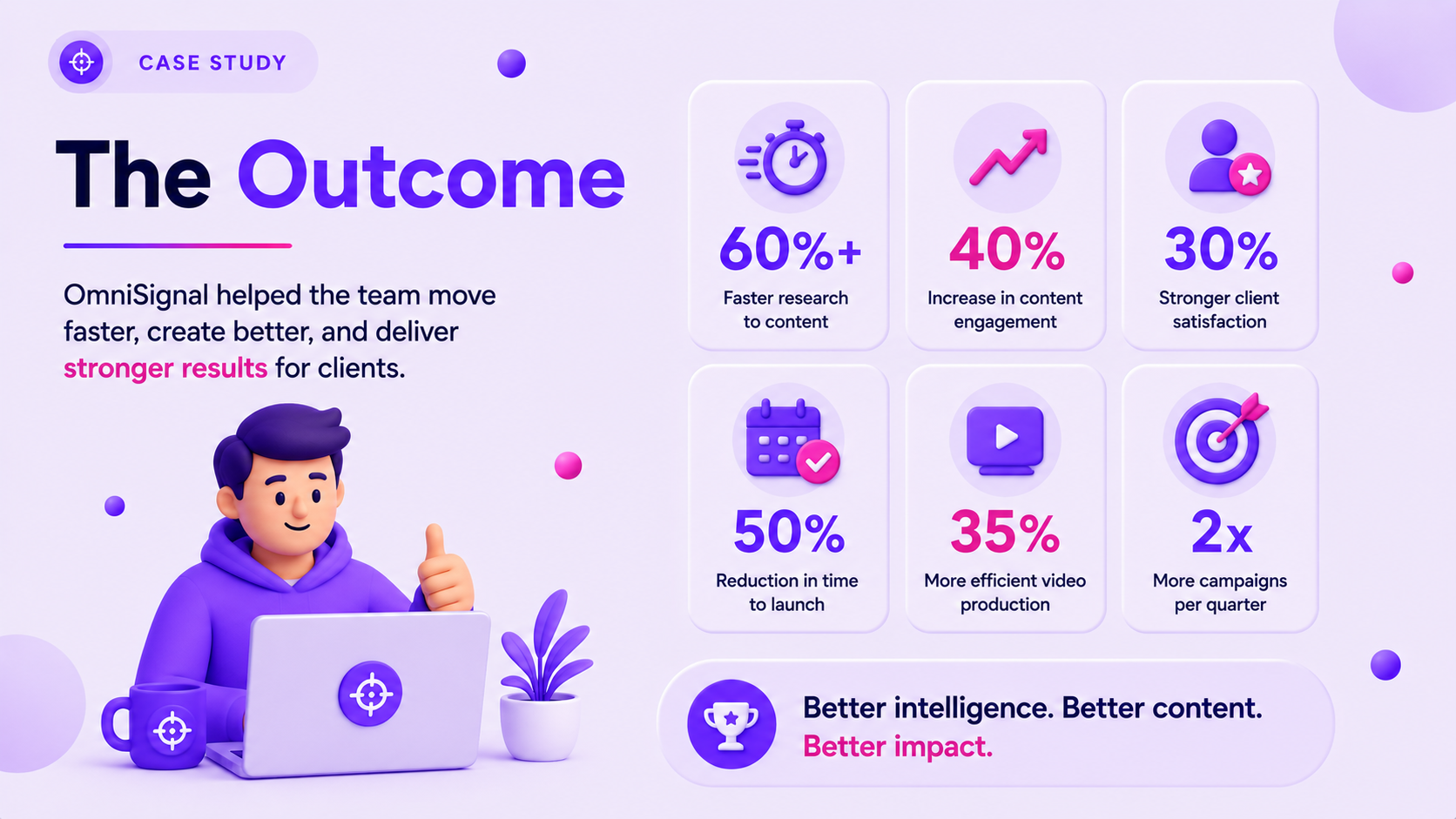
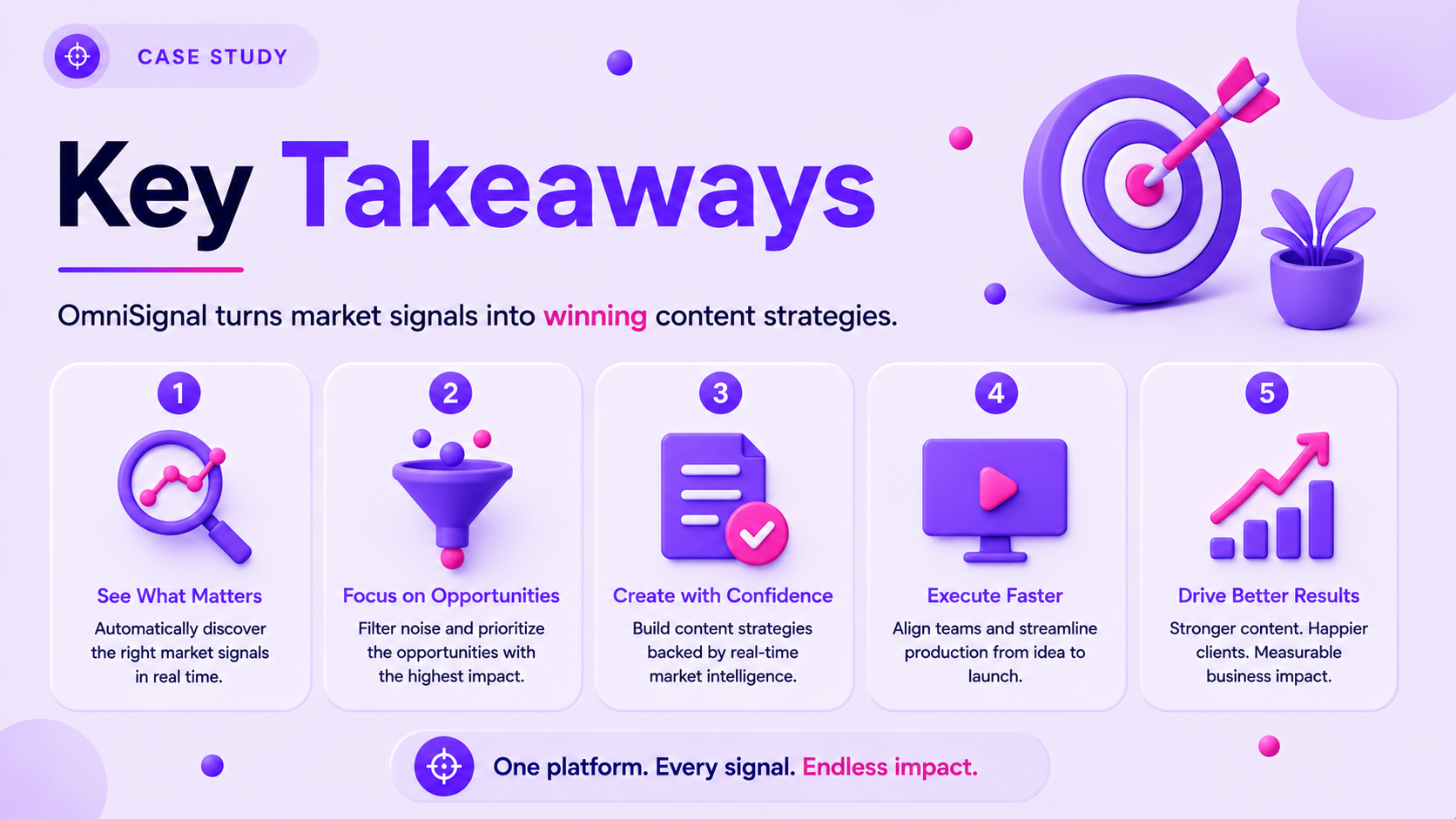
1. Faster research-to-content workflow
The team reduced the time spent on manual research and moved faster from market insight to content production.
Researchers no longer had to assemble fragmented inputs from scratch. Strategists received cleaner signal summaries. Creators started with sharper angles.
2. Better content quality
Content became more specific, timely, and differentiated.
Instead of producing generic posts around broad trends, the team created content based on:
- Competitor gaps
- Emerging narratives
- Customer pain points
- Category shifts
- Proven content formats
This improved both strategic quality and creative direction.
3. Stronger client trust
OmniSignal helped the agency explain the logic behind its recommendations.
Clients could see that strategy was not based only on taste or intuition. It was supported by real market signals.
This made approvals easier and reduced subjective feedback.
4. Better team alignment
Marketers, researchers, designers, and video producers worked from the same intelligence layer.
Everyone understood:
- What trend mattered
- Why it mattered
- Which audience pain point it connected to
- What content angle should be used
- Which format made sense
This reduced misalignment between strategy and production.
5. More scalable strategy work
Senior strategists were no longer the only source of market context.
OmniSignal helped standardize how the team discovered opportunities, prioritized content, and created campaign briefs.
This made it easier to onboard new team members and manage more clients without lowering quality.
Final Result
For an agency-style marketing team like Factory39, OmniSignal turns content strategy from a manual research process into a repeatable intelligence system.
The team stops asking:
“What should we post about?”
And starts asking:
“Which market signal should we act on first?”
Summary
Problem:
Market research was fragmented across people, tools, tabs, and documents. Content teams moved slowly and often created campaigns without a clear connection to live market movement.
Solution:
OmniSignal created a shared signal layer for researchers, strategists, content creators, designers, video producers, and account managers. It automated signal discovery and turned market movement into campaign opportunities.
Outcome:
The team produced sharper campaigns faster, improved client trust, aligned strategy with production, and scaled content intelligence across multiple clients.