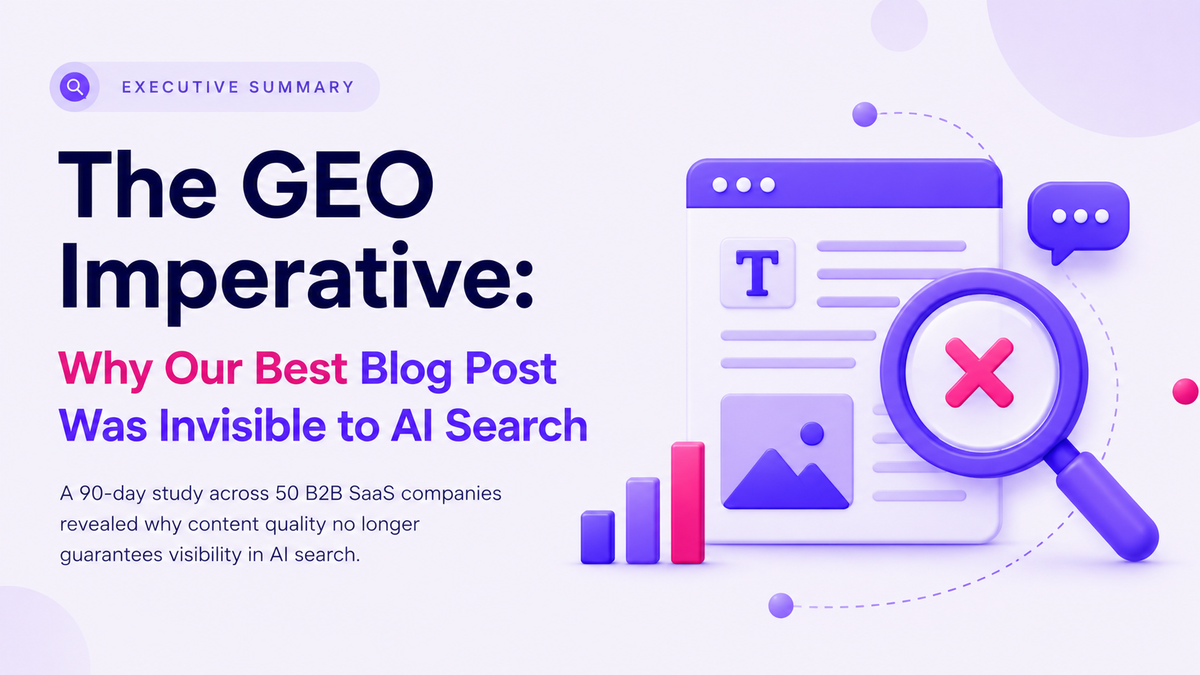
The GEO Imperative: Why Our Best Blog Post Was Invisible to AI Search

Executive Summary
We expected content quality to drive AI citations.
After all, that's how most marketers have been trained to think about search for the last two decades: create better content, earn authority, rank higher.
Then something unexpected happened.
During a 90-day study tracking 50 B2B SaaS companies across ChatGPT, Perplexity, and Claude, our highest-performing blog article received almost no AI citations.
Meanwhile, a competitor's outdated pricing page appeared in generated responses 23 times.
That observation challenged one of our core assumptions and led us to investigate a new discipline emerging alongside traditional SEO:
Generative Engine Optimization (GEO).
What we discovered suggests that AI search visibility is governed by entirely different mechanisms than traditional search rankings.
The implications for B2B marketing teams are significant.
The Shift from Ranking Algorithms to Citation Algorithms
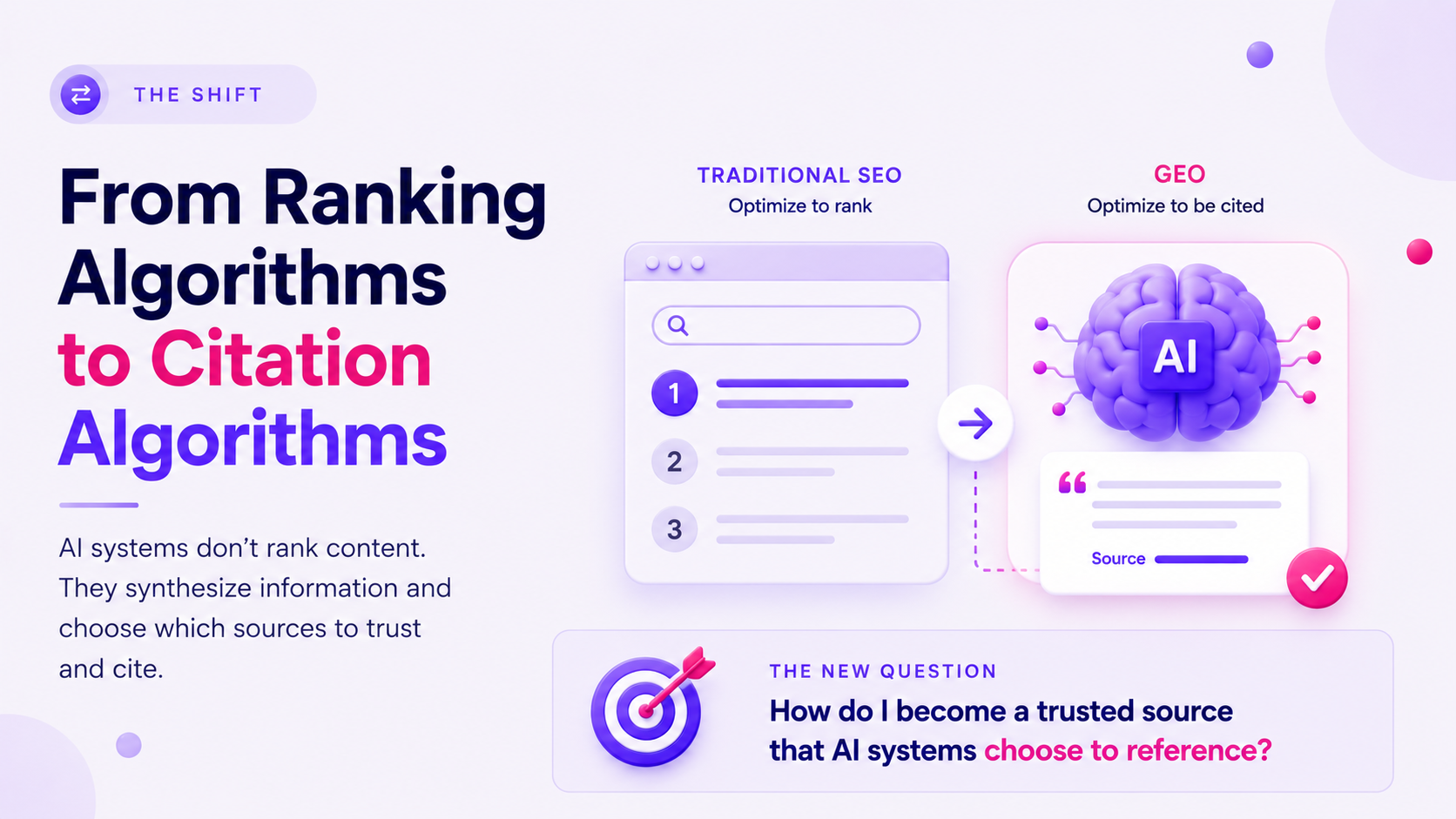
Traditional SEO optimizes for ranking algorithms.
Google evaluates pages and determines where they should appear in search results.
GEO operates differently.
AI systems don't simply rank content.
They synthesize information and decide which sources deserve citation, attribution, and inclusion in generated responses.
This creates a fundamentally different optimization challenge.
The question is no longer:
"How do I rank first?"
The question becomes:
"How do I become a trusted source that AI systems choose to reference?"
Those are not the same problem.
Methodology: 90 Days Across Three AI Platforms
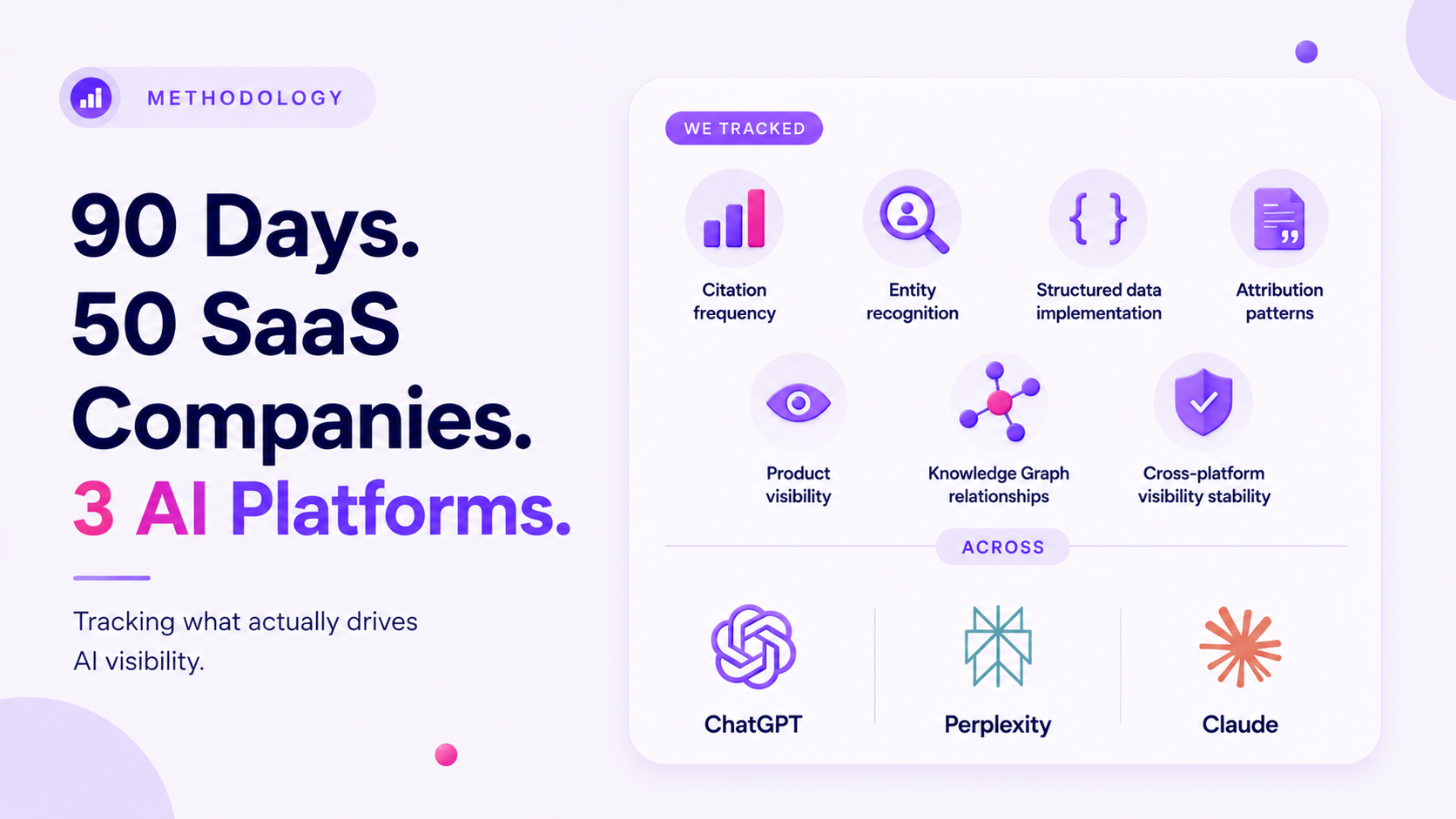
To understand what drives AI visibility, we tracked 50 B2B SaaS companies over a 90-day period.
Our research focused on:
- Citation frequency
- Entity recognition consistency
- Structured data implementation
- Attribution patterns
- Product visibility
- Knowledge Graph relationships
- Cross-platform visibility stability
The study covered three major AI systems:
- ChatGPT
- Perplexity
- Claude
Each platform was evaluated using identical query frameworks and tracked repeatedly over time to identify persistent visibility patterns.
Our expectation was straightforward:
Higher SEO authority should correlate strongly with AI citations.
The data showed otherwise.
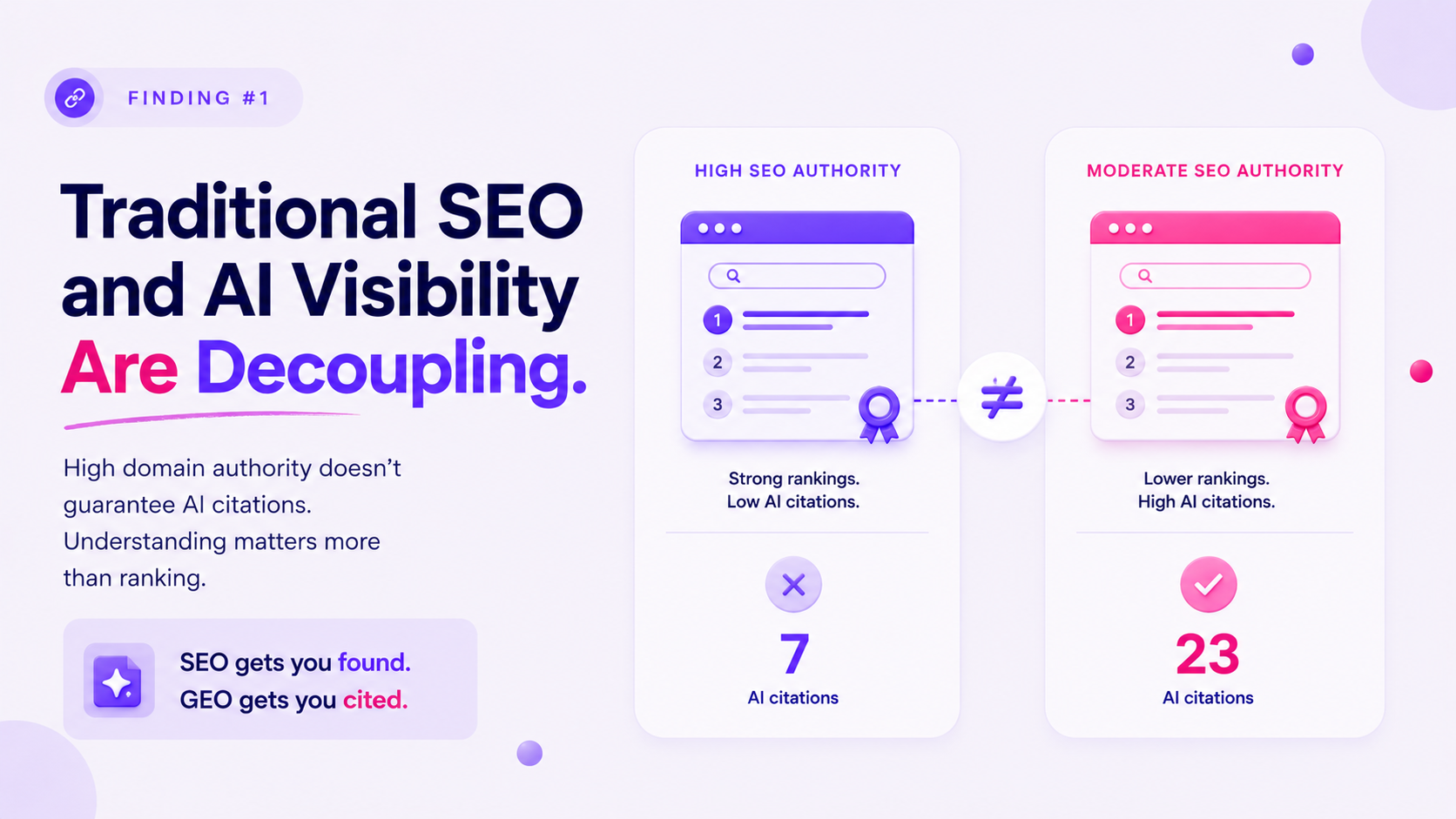
Finding #1: Traditional SEO and AI Visibility Are Decoupling
The most surprising finding was the absence of a meaningful relationship between conventional SEO authority and AI citation frequency.
Several companies with strong domain authority and extensive content libraries appeared infrequently in AI-generated responses.
Meanwhile, organizations with relatively modest SEO footprints surfaced consistently.
The correlation was weak enough to challenge the assumption that SEO success naturally translates into AI search success.
This does not mean SEO is becoming irrelevant.
It means SEO alone is no longer sufficient.
A website can be highly visible to search engines while remaining difficult for AI systems to understand.
And understanding appears to matter more than ranking.
Finding #2: Structured Data Was the Strongest Visibility Signal
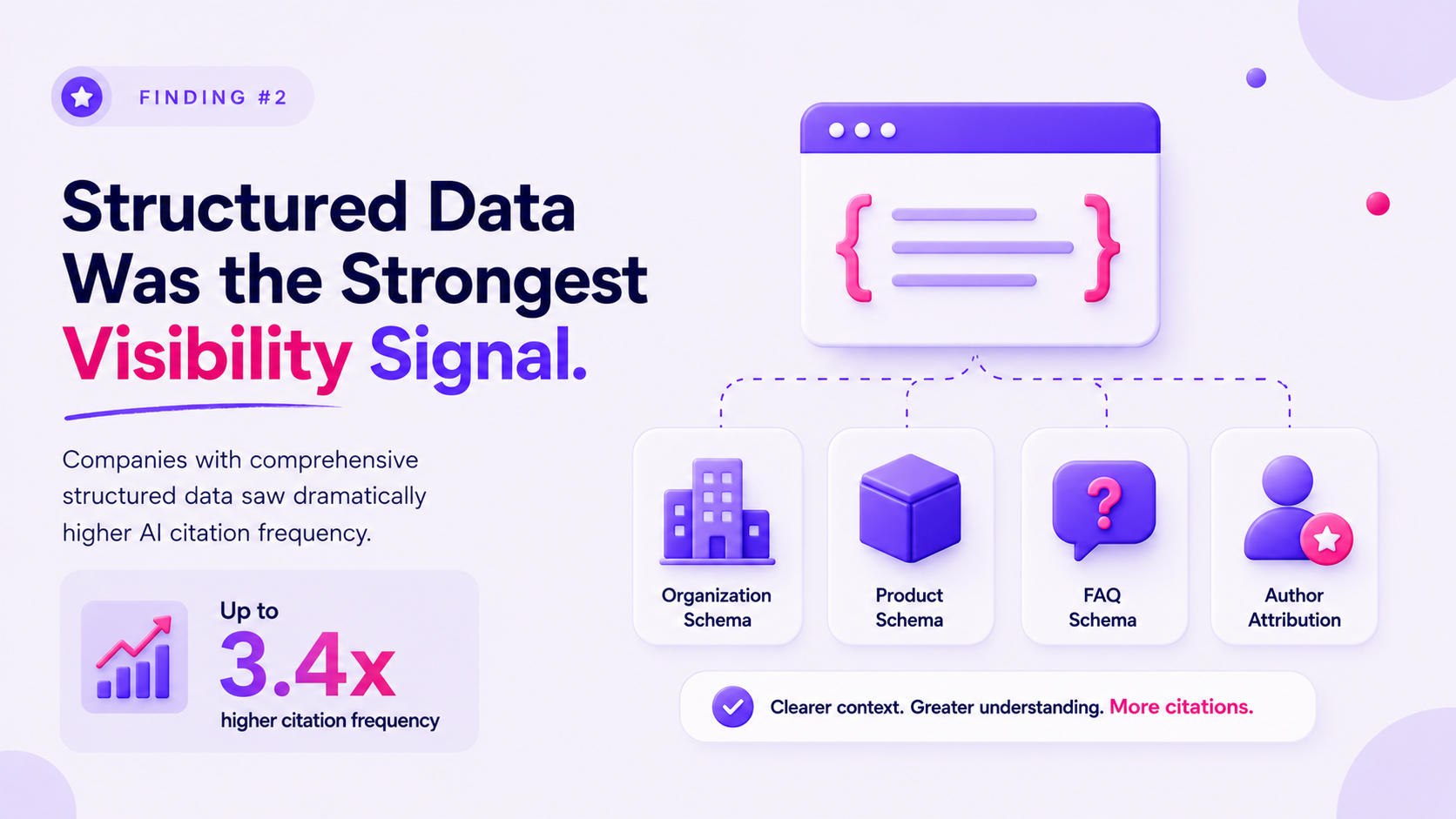
Across all platforms, structured business context emerged as the strongest predictor of citation frequency.
Companies implementing comprehensive:
- Organization Schema
- Product Schema
- FAQ Schema
- Author Attribution Structures
experienced significantly stronger AI visibility.
The highest-performing implementations achieved:
Up to 3.4x higher citation frequency
compared to companies with incomplete or fragmented structured data.
The pattern was remarkably consistent.
The winning companies were not necessarily publishing more content.
They were making themselves easier for machines to understand.
Finding #3: Every AI Platform Behaves Differently
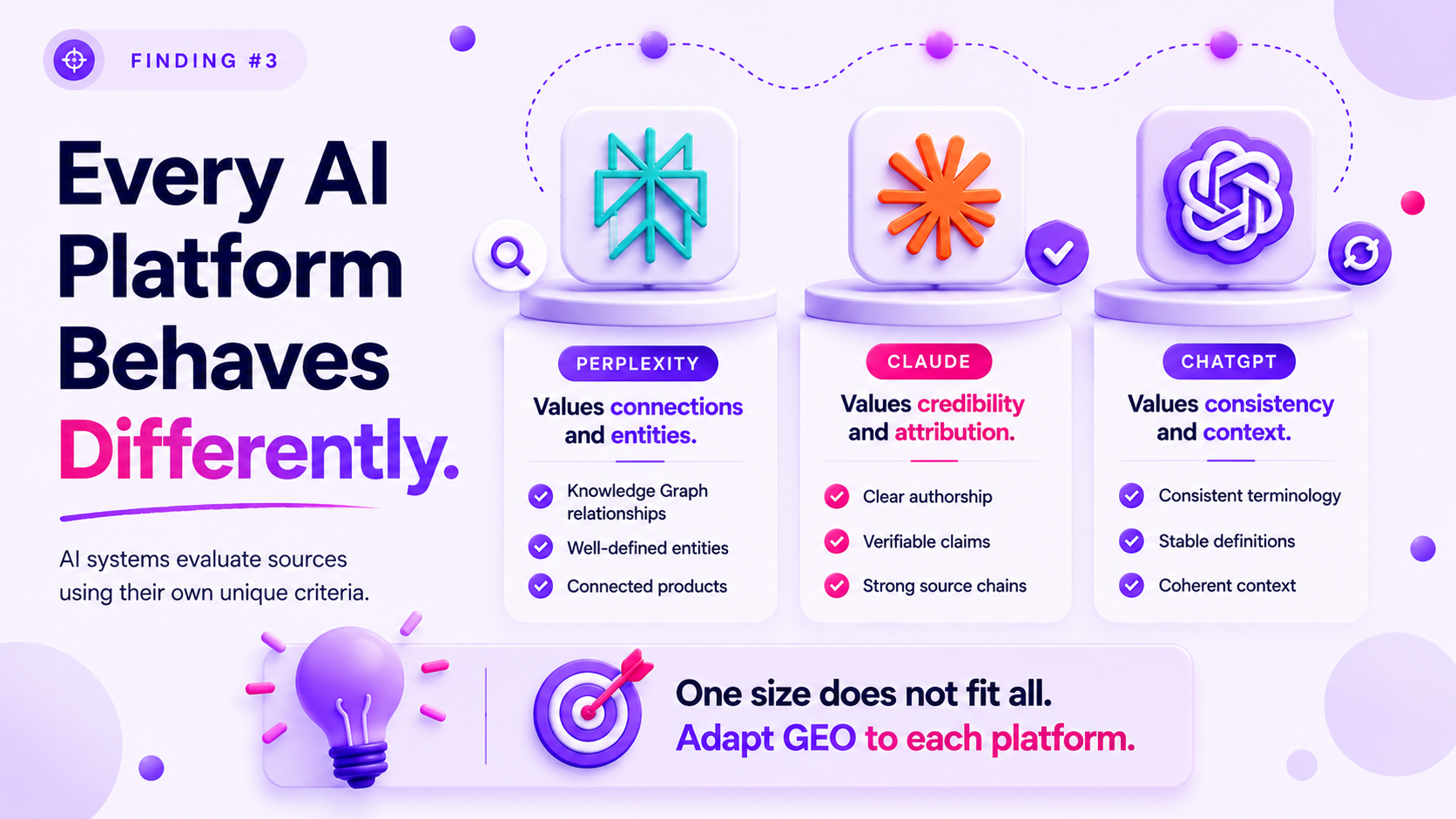
One of the most important discoveries was that AI systems do not evaluate sources identically.
Each platform demonstrated distinct preferences.
Perplexity
Perplexity showed the strongest dependence on Knowledge Graph relationships.
Companies with:
- well-defined entities
- connected products
- structured organizational relationships
performed substantially better.
Entity consistency appeared more important than content volume.
Claude
Claude favored attribution quality.
Sources containing:
- clear authorship
- verifiable claims
- transparent references
- strong source chains
were cited more frequently.
Claude appeared particularly sensitive to credibility structures.
ChatGPT
ChatGPT rewarded contextual consistency.
The strongest performers maintained:
- consistent terminology
- stable product definitions
- coherent organizational descriptions
across all digital properties.
Companies with fragmented messaging frequently experienced lower citation visibility.
The Real Problem Isn't Content
One conclusion emerged repeatedly throughout the study.
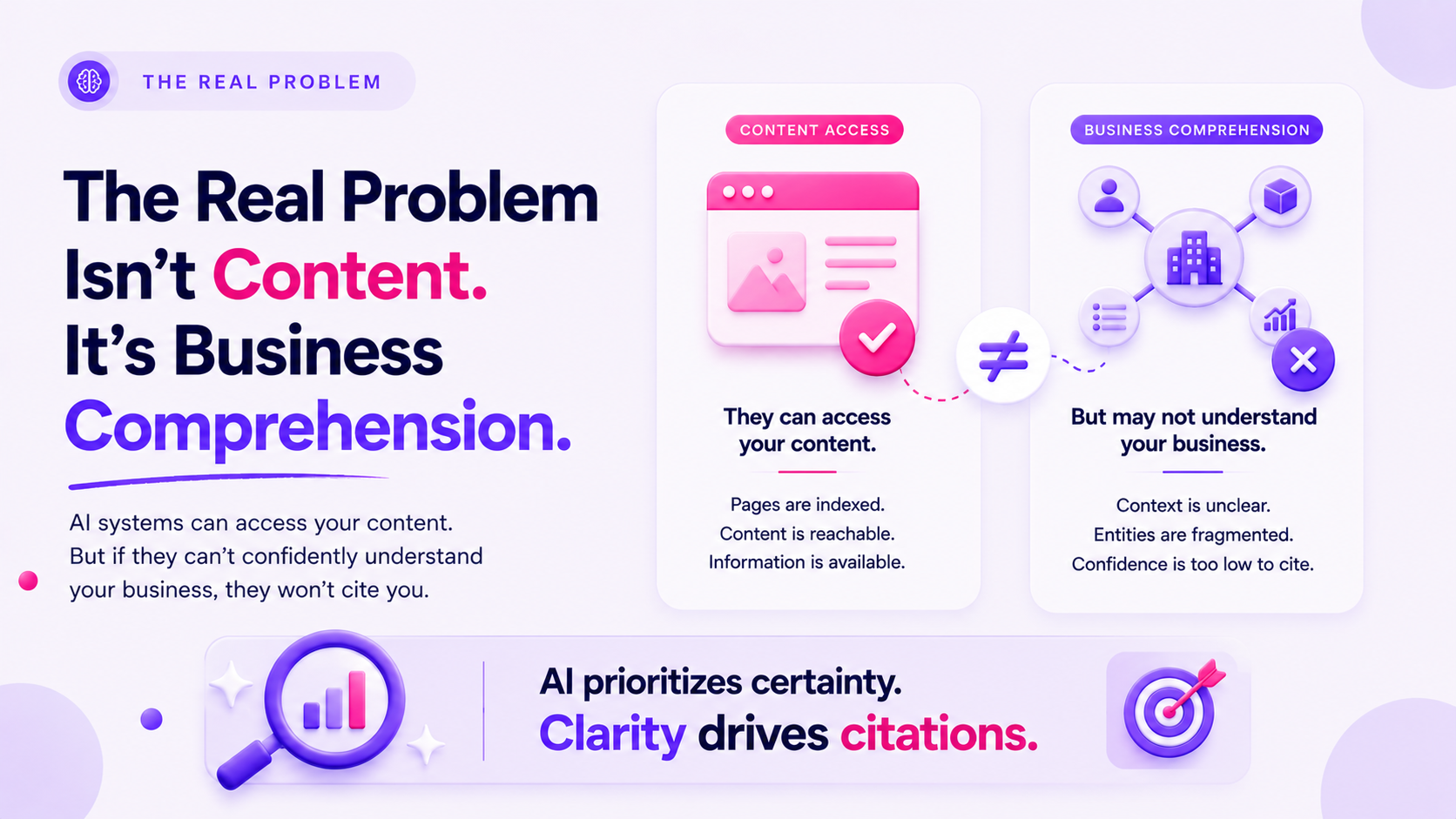
The challenge is rarely content quality.
The challenge is business comprehension.
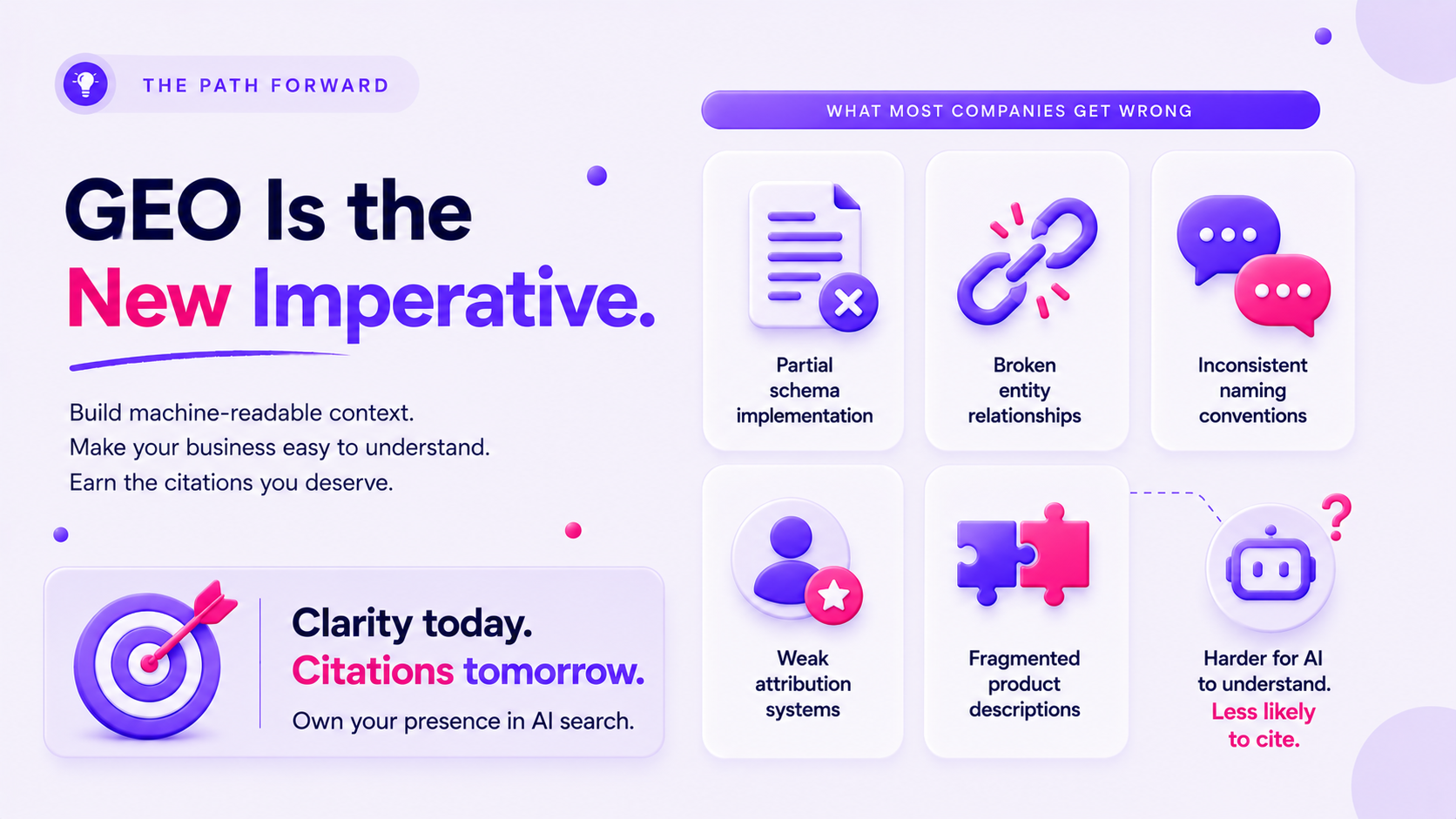
Most companies had:
- Partial schema implementation
- Broken entity relationships
- Inconsistent naming conventions
- Weak attribution systems
- Fragmented product descriptions
As a result:
AI systems could access the content.
But they struggled to confidently understand the company behind it.
This distinction is becoming increasingly important.
Because AI systems appear to prioritize certainty.
When organizational context is ambiguous, citation likelihood decreases.
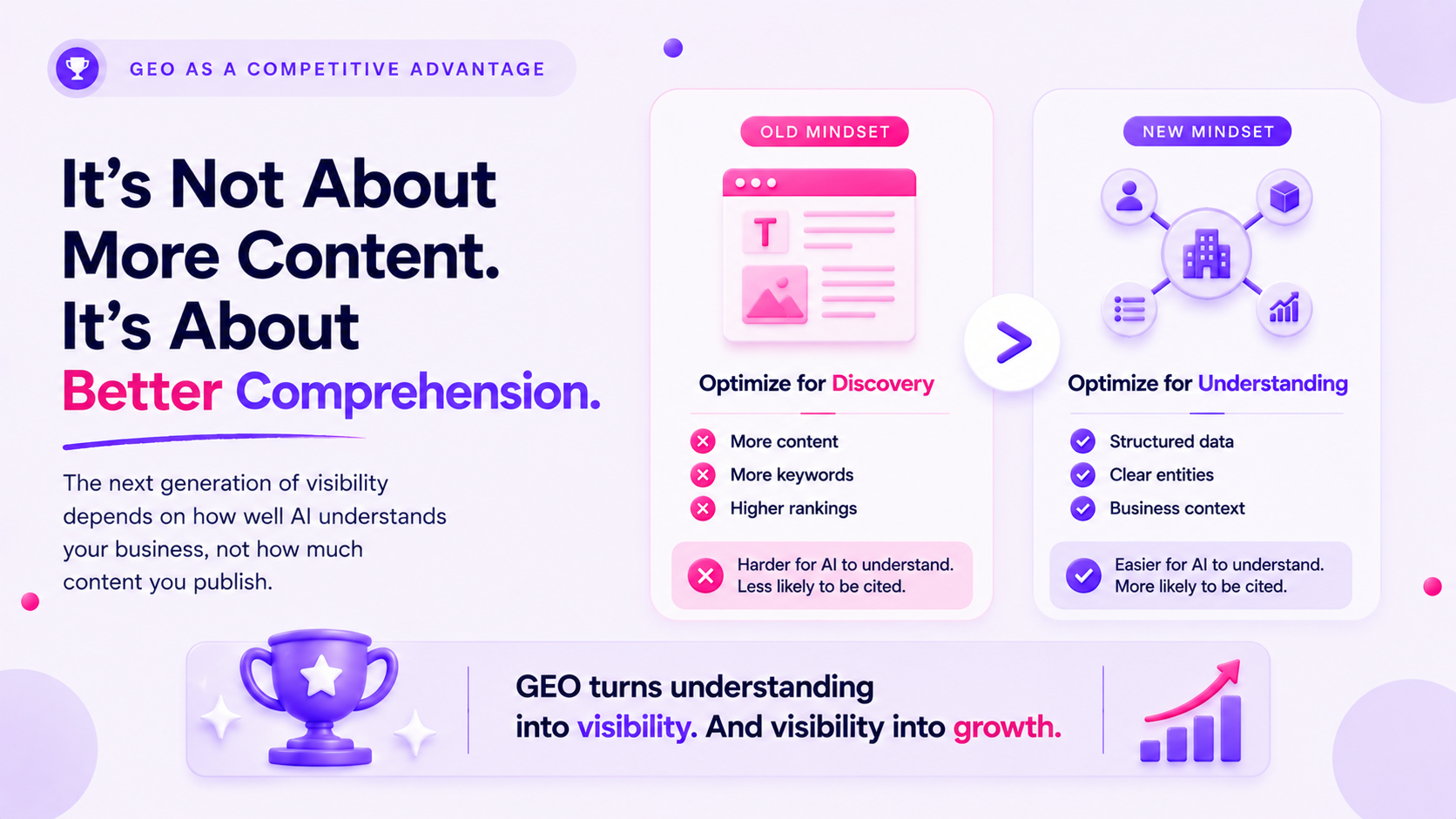
GEO as a New Competitive Advantage
The next generation of digital visibility may depend less on publishing more content and more on building machine-readable business context.
This represents a meaningful shift in marketing priorities.
Historically, marketers optimized for discovery.
Now they must optimize for understanding.
The organizations that succeed will likely be those that create:
- Clear entity relationships
- Strong attribution structures
- Consistent product definitions
- Comprehensive schema coverage
- Machine-readable organizational context
In other words:
The future of visibility belongs to companies that AI can understand, not just crawl.
What Marketing Leaders Should Do Next
For most B2B SaaS companies, the opportunity is surprisingly practical.
Start with:
- Auditing existing schema implementation
- Defining organizational entities clearly
- Structuring product information consistently
- Strengthening attribution systems
- Monitoring AI citation visibility alongside traditional SEO metrics
The gap between companies that have done this work and those that have not is already becoming visible.
And we believe that gap will widen significantly over the next 24 months.
The companies that prepare early will gain a disproportionate advantage as AI search becomes a primary discovery channel.
Because in the emerging GEO era, being found is no longer enough.
You also need to be understood.