LinkedIn Algorithm 2026: Why Posting Less Increased Engagement (And How to Turn Every Like Into a Lead)

21 Sept 2026 · @Sergey Grizzly
If you've been posting on LinkedIn every day and watching engagement flatten out, the data says you might be doing too much.
An August 2026 analysis of more than 35,000 LinkedIn posts across five follower brackets found that accounts posted less last month and got more engagement anyway.
At CrossLike, we spend our days turning LinkedIn engagement into warm leads, so a shift like this matters to anyone building pipeline from content, not just reach. Here's exactly what the data shows, and how to use it.
How Often Should You Post on LinkedIn in 2026?
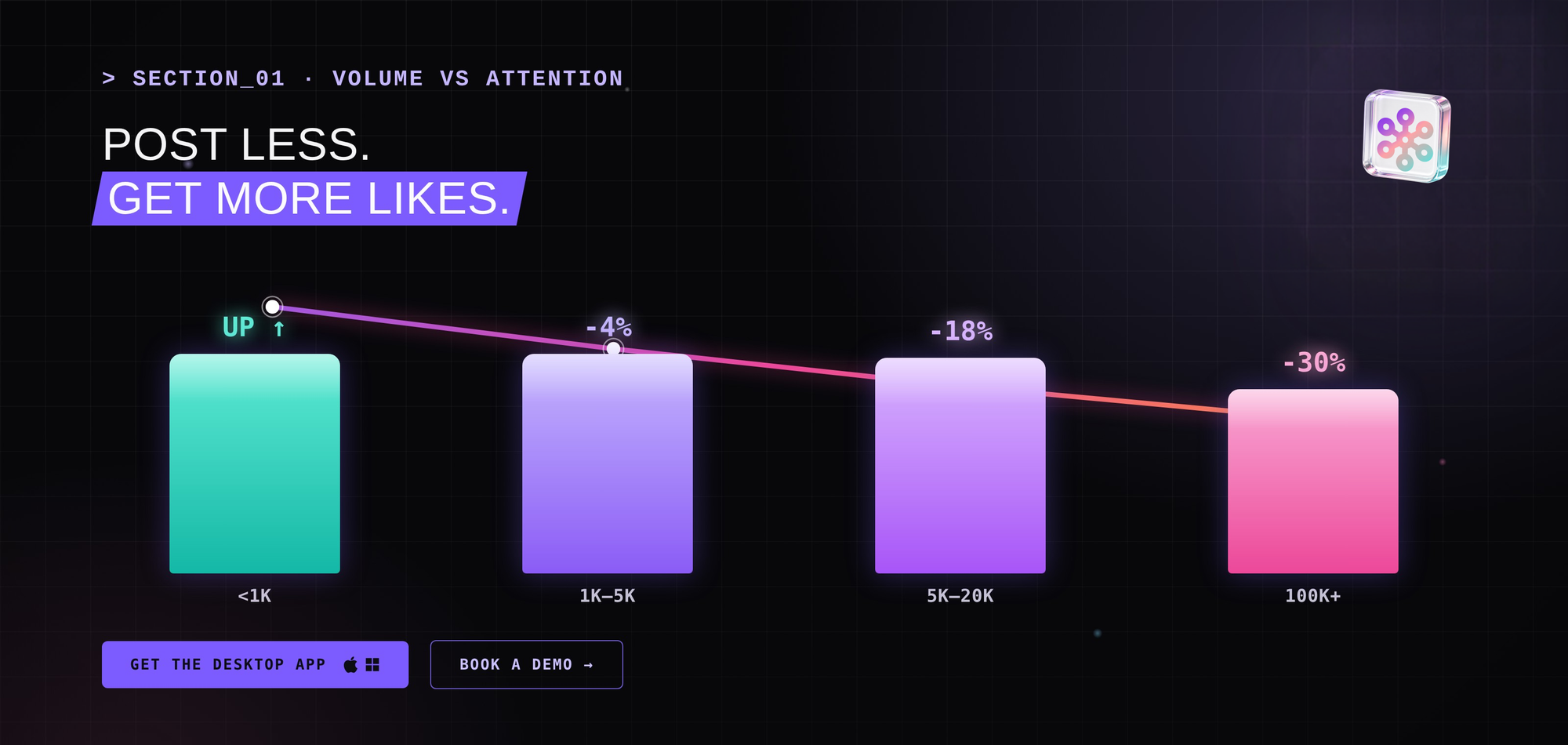
Median posts per week fell almost everywhere in August: down 4% for accounts with 1,000–5,000 followers, down 18% for 5,000–20,000, and down 30% for accounts above 100,000. Only the smallest bracket — accounts still building their first audience — posted more.
Despite fewer posts, median likes per post rose in every bracket, and engagement rate climbed in four of the five (flat in the fifth).
Comments didn't follow the same curve: median comments per post fell 7% in the 5,000–20,000 bracket and 11% in the 20,000–100,000 bracket.
Audiences are rewarding scarcity with likes, not with discussion — which matters if you're using LinkedIn for lead generation rather than just reach. A like is a weaker buying signal than a comment or a profile click, and it's exactly the kind of signal that's easy to miss by hand and easy for a tool like CrossLike to catch and turn into a warm lead automatically.
What's the Ideal LinkedIn Post Length for Engagement?
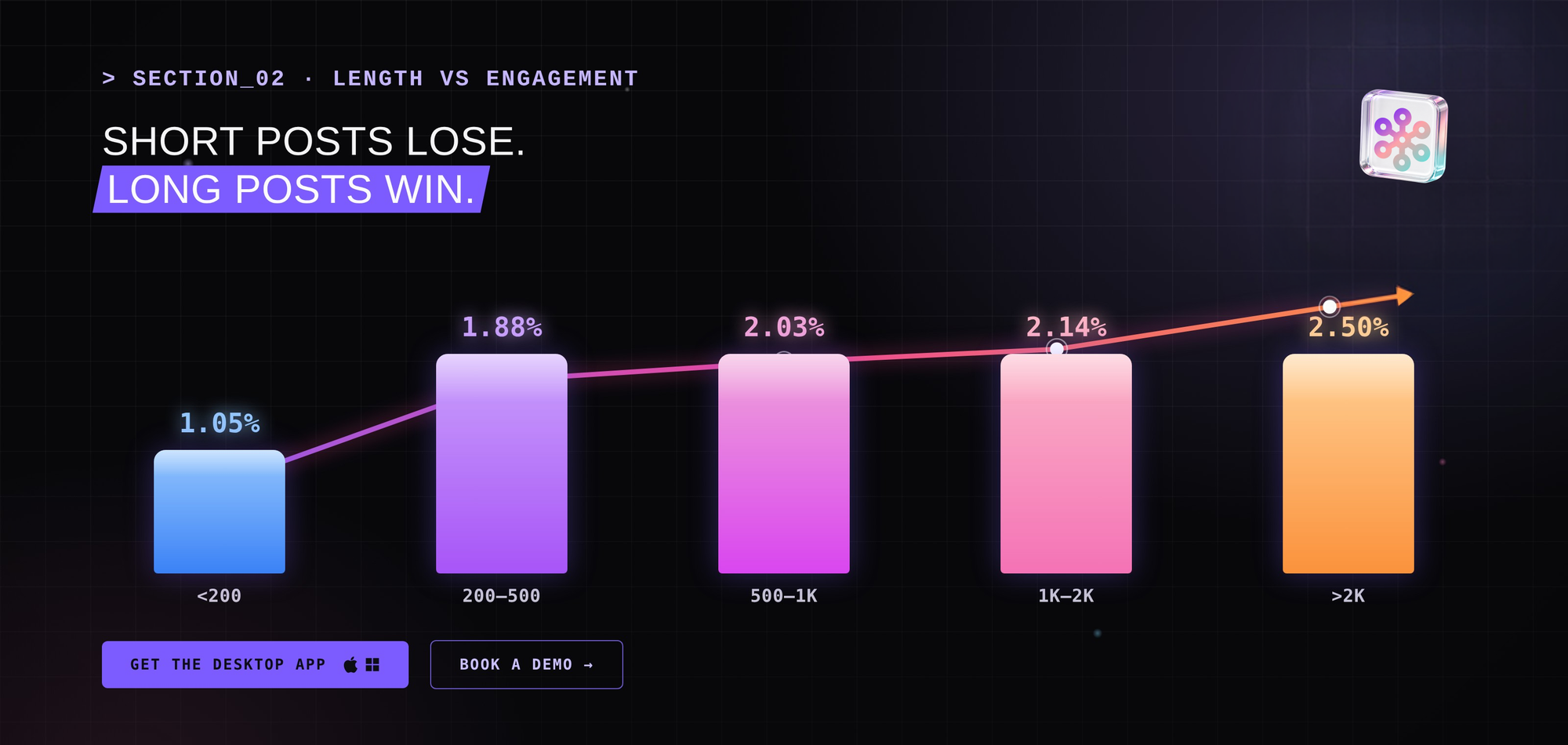
Posts over 2,000 characters had the highest median engagement rate across all five follower brackets, without exception — one of the only findings in the dataset that holds true no matter your audience size.
In the 5,000–20,000 follower bracket, engagement rate climbed steadily with length: 1.05% under 200 characters, 1.88% at 200–500, 2.03% at 500–1,000, 2.14% at 1,000–2,000, and 2.50% above 2,000 characters.
That's more than double the engagement rate for a long post versus a short one, on the exact same audience. If you're optimizing for LinkedIn reach in 2026, length is one of the few levers that works in every bracket.
Images vs. Video vs. Text: The Best LinkedIn Post Format
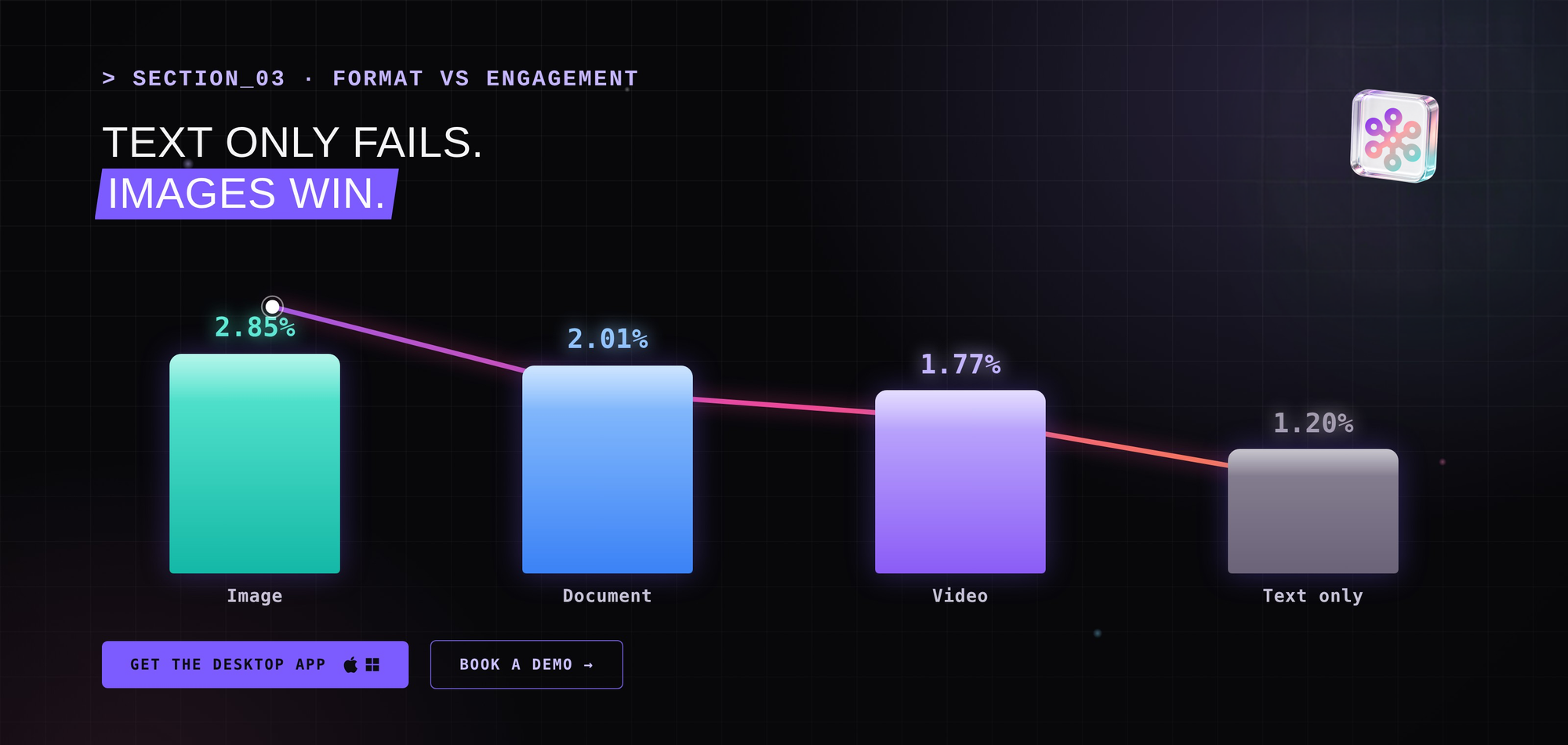
Across every follower bracket, image posts outperformed text, video, and document posts. In the 5,000–20,000 bracket, the ranking by median engagement rate was image (2.85%), document (2.01%), video (1.77%), and text only (1.20%). The image result is the one worth building your content calendar around: it's backed by nearly 1,750 posts in this bracket alone, and it wins in every single bracket in the dataset.
Document and video swap places between brackets on much smaller sample sizes, so treat those two as a hint rather than a rule — but skipping visuals altogether is the one format choice the data clearly punishes. That lines up with the broader market: Socialinsider's 2026 LinkedIn benchmarks, drawn from a larger cross-industry sample, similarly found visual formats — native documents (7.00%) and multi-image carousels (6.45%) — pulling higher engagement than plain text, even as the exact format ranking shifts by dataset.
What's the Best Day to Post on LinkedIn?
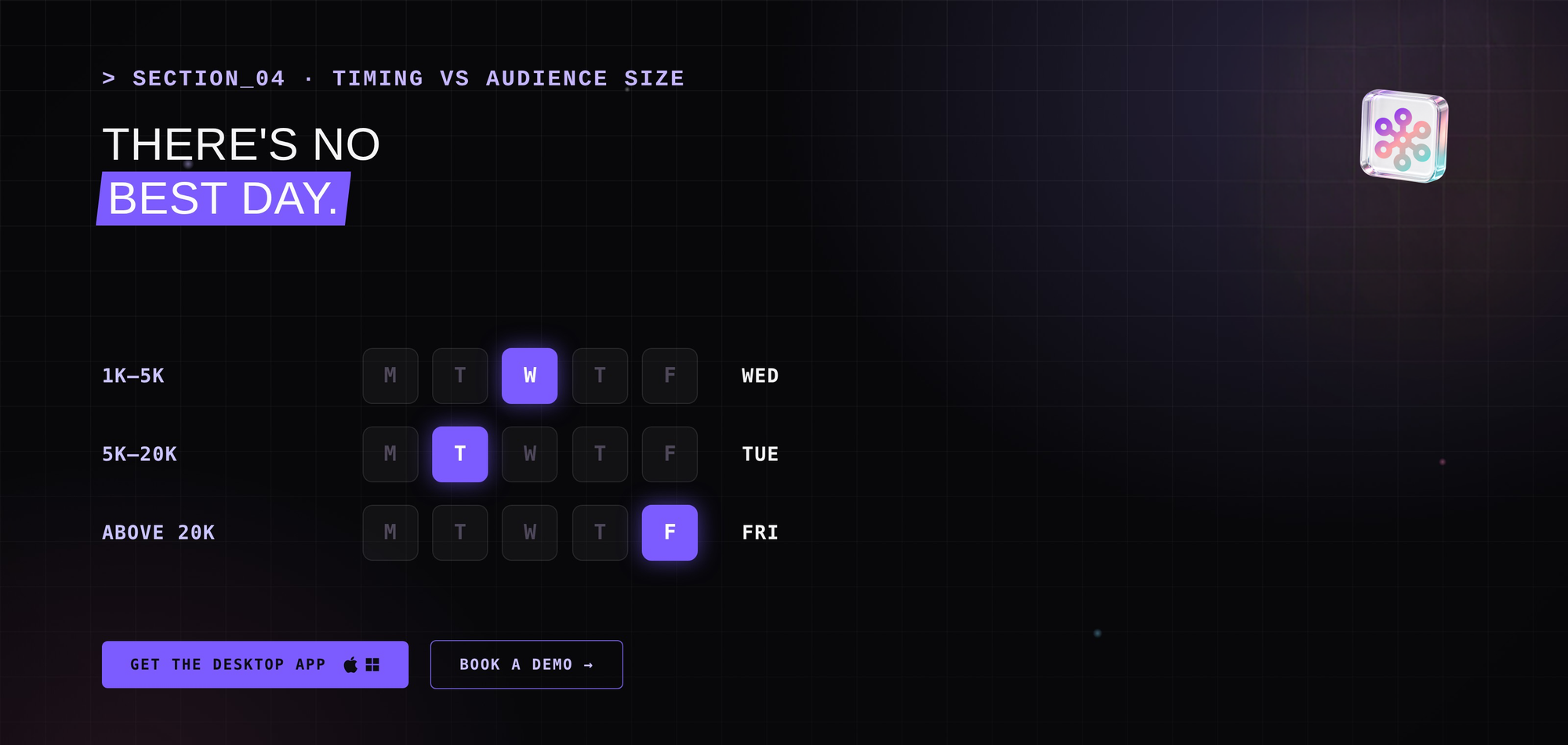
The honest answer: it depends on the size of your audience — and August proved it. The peak posting day shifted by follower bracket:
Follower bracket | Peak day in August |
|---|---|
1,000–5,000 | Wednesday |
5,000–20,000 | Tuesday |
Above 20,000 | Friday |
Generic "best day to post on LinkedIn" advice averages away the one variable that actually decides the answer — how big your audience already is. Track your own bracket's peak day instead of copying a generic content calendar. As a general starting point, Buffer's analysis of 4.8 million LinkedIn posts found Wednesday through Friday outperforming Monday and Tuesday overall — a reasonable baseline until your own bracket's data says otherwise.
Turn Every Like Into a Lead with CrossLike
Posting less, longer, and with an image will get you more likes in 2026 — that part is settled. What most teams miss is that likes, comments, and profile views are already telling you who's warm and ready for outreach; they just never turn that engagement into an actual contact list.
That's the exact gap CrossLike closes: it tracks who engages with your LinkedIn content in real time, filters the real signal from the noise, and turns it into a warm lead list with built-in outreach — no per-lead credits, no manual scraping, no guessing who to message next.
If your content is already earning the engagement, CrossLike makes sure none of it goes to waste. Book a demo to see your own engagement turned into pipeline.
LinkedIn Posting FAQ
How often should I post on LinkedIn? Less than you might think, if your goal is engagement rather than raw output. An August 2026 analysis of LinkedIn posting activity found posting volume down in four of five follower brackets while engagement rose anyway — consistency and quality mattered more than frequency.
What's the best LinkedIn post length in 2026? Posts over 2,000 characters had the highest engagement rate in every follower bracket tested — more than double the rate of posts under 200 characters in the 5,000–20,000 bracket.
Do images perform better than video on LinkedIn? In August 2026, yes. Image posts beat video, documents, and text-only posts in every follower bracket, pulling roughly 2.85% engagement versus 1.77% for video in the 5,000–20,000 bracket.
What's the best time to post on LinkedIn? There isn't one universal answer. Peak engagement day moved with audience size — Wednesday for 1,000–5,000 followers, Tuesday for 5,000–20,000, and Friday above 20,000 — so the right day depends on your own bracket, not a generic calendar.
How do I turn LinkedIn engagement into leads? Manually, by tracking who likes, comments, and views your profile after each post — or automatically with a tool like CrossLike, which detects real engagement on your content and turns it into a warm lead list with built-in outreach.