
Why OmniSignal AI Outperforms Traditional GTM & Inbound Marketing Tools in 2026

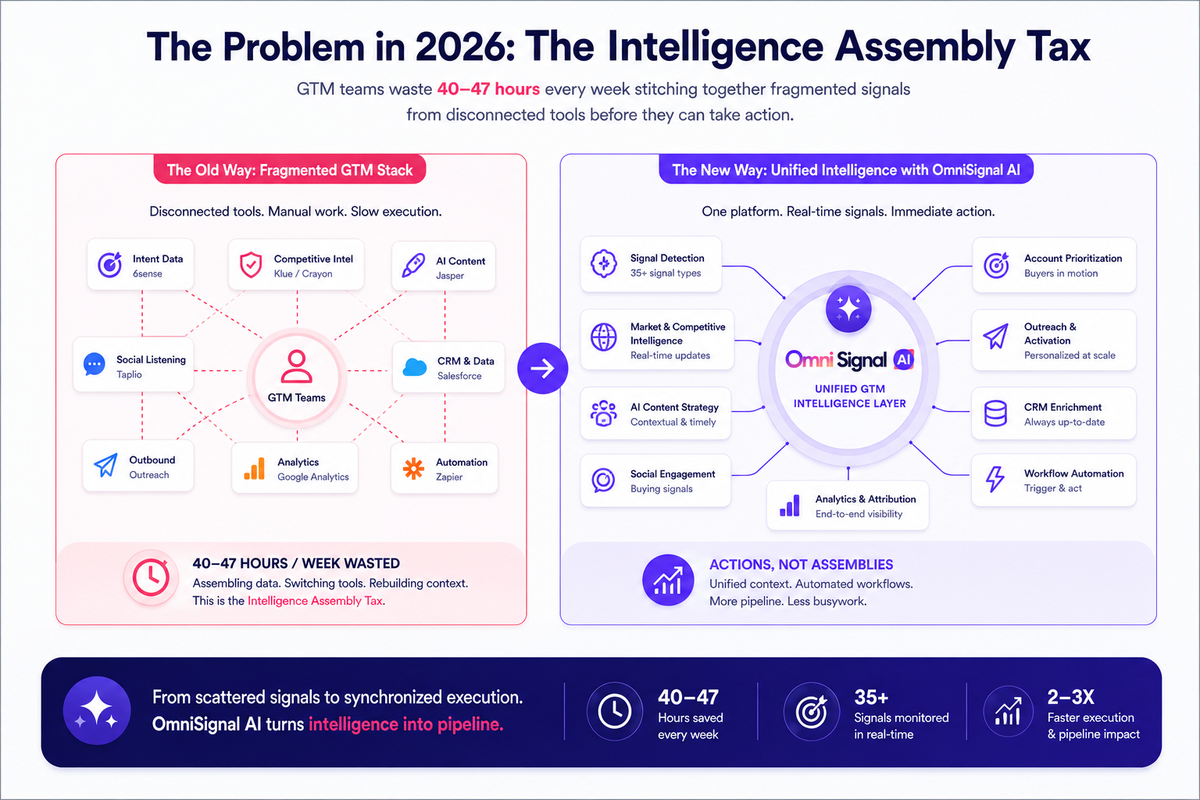
Traditional inbound marketing is breaking down in 2026.
AI assistants now answer questions directly inside search results, reducing organic website clicks dramatically. At the same time, B2B buyers spend less time actively researching vendors, making timing and relevance more important than ever.
To adapt, revenue teams adopted dozens of specialized GTM tools:
- intent data platforms
- competitive intelligence software
- AI content generators
- social listening tools
- outbound automation systems
But instead of increasing execution speed, most teams created a new operational problem:
The Intelligence Assembly Tax
GTM teams now spend hours every week stitching together fragmented context across disconnected systems before they can take action.
Based on internal research across 100+ GTM teams, companies waste an average of 40–47 hours every week assembling intelligence across CRMs, Slack conversations, dashboards, spreadsheets, intent platforms, social analytics, and competitor tracking systems.
This is why the market is shifting toward a new category:
Signal-Driven Inbound Strategy
OmniSignal AI was built specifically for this transition.
Instead of operating as another isolated point solution, OmniSignal combines:
- market intelligence
- signal detection
- AI-powered inbound strategy
- competitive monitoring
- contextual content generation
- pipeline activation
- outreach orchestration
into one unified GTM intelligence layer.
In this guide, we compare OmniSignal AI against leading inbound marketing, ABM, competitive intelligence, and AI GTM platforms to explain why unified signal-driven systems outperform fragmented software stacks in 2026.
What Is OmniSignal AI?
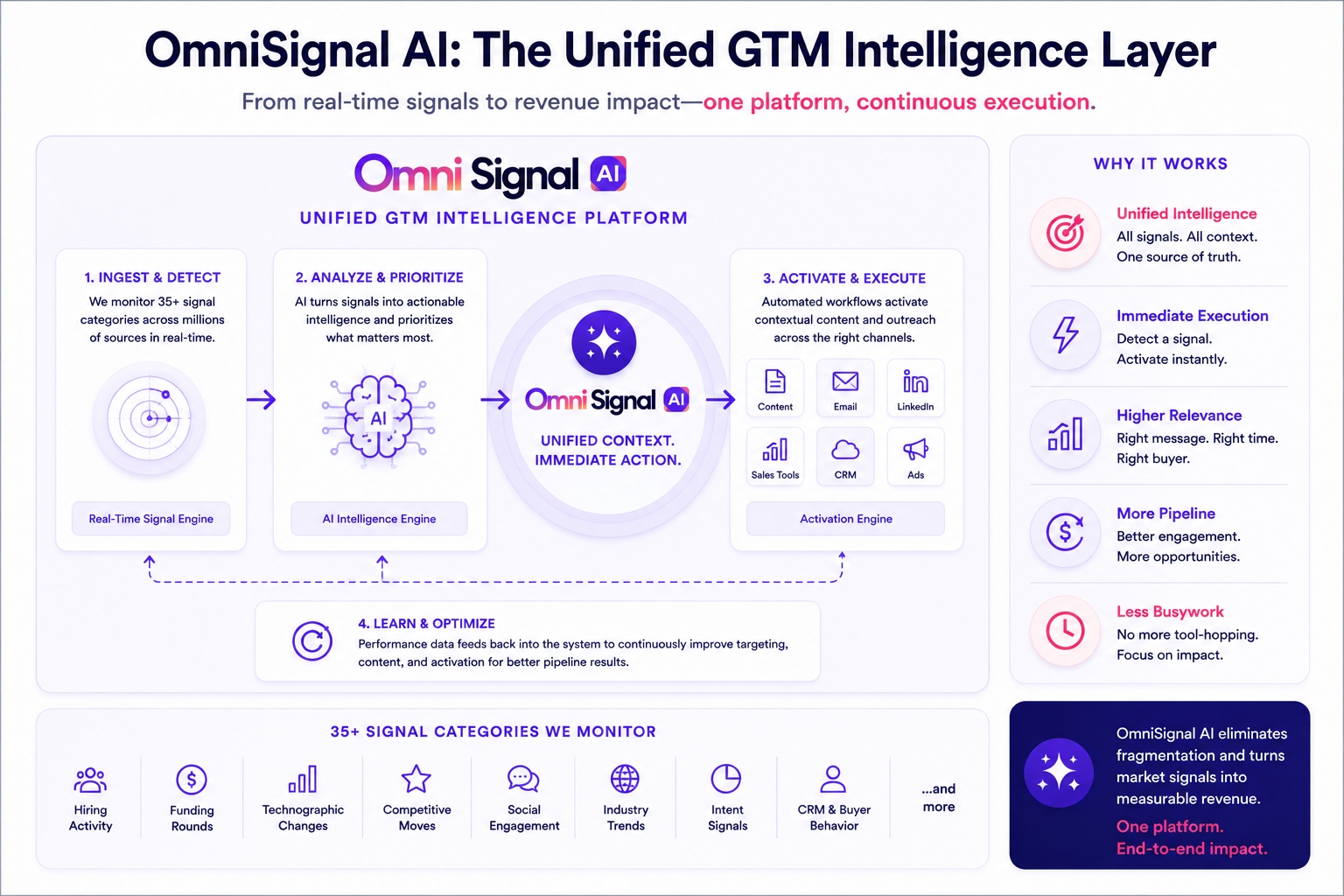
OmniSignal AI is a signal-driven GTM intelligence platform designed to transform real-time market signals into executable revenue actions.
Unlike traditional software stacks where teams manually move information between disconnected systems, OmniSignal continuously monitors external and internal GTM signals to:
- identify buyers in motion
- detect competitive opportunities
- generate contextual content strategies
- prioritize pipeline actions
- activate personalized outreach
The platform analyzes 35+ signal categories, including:
- hiring activity
- funding rounds
- competitor movements
- technographic changes
- social engagement
- market trends
- buyer intent signals
- CRM activity
- website behavior
The result is a unified inbound and outbound intelligence layer built for modern revenue teams.
Why Point Solutions Create GTM Complexity
Modern GTM teams rarely lack tools.
They lack operational alignment.
Most companies now combine multiple platforms for:
- ABM and buyer intent
- AI content generation
- competitive intelligence
- social media growth
- CRM enrichment
- outbound sequencing
- analytics and reporting
While each platform solves an isolated workflow problem, the overall system becomes operationally fragmented.
This creates what OmniSignal calls:
The Intelligence Assembly Tax
The hidden operational cost of manually assembling context before execution can happen.
Instead of moving faster, teams become trapped in:
- dashboard switching
- duplicated research
- inconsistent messaging
- stale intelligence
- disconnected workflows
- delayed decisions
The result is slower GTM execution despite larger software investments.
OmniSignal AI vs 6sense & Demandbase
Use Case: Account-Based Marketing & Buyer Intent
How Traditional ABM Platforms Work
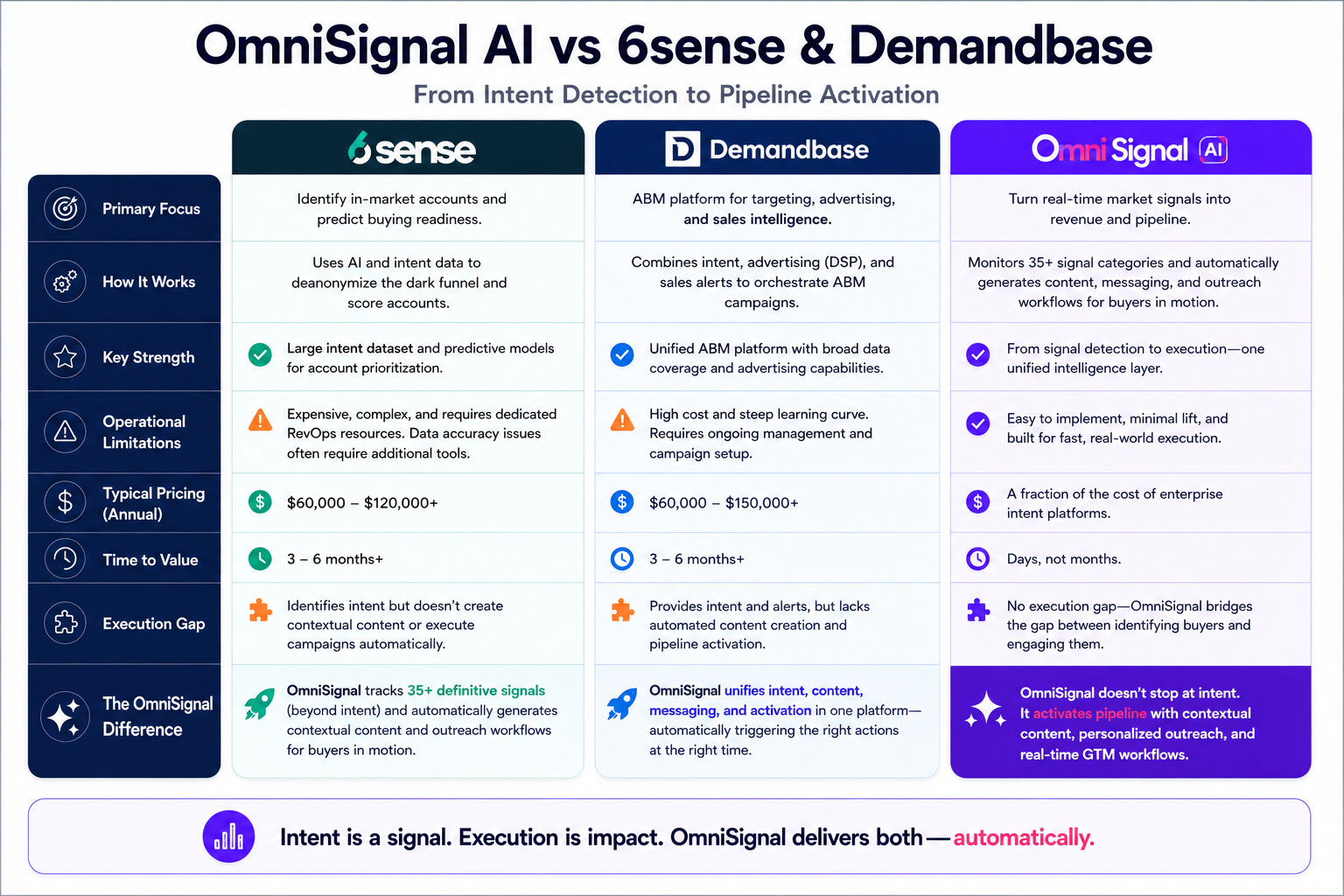
Platforms like 6sense and Demandbase focus heavily on buyer intent and account-based marketing.
6sense uses predictive AI models to identify in-market accounts and detect buying readiness across the “dark funnel.”
Demandbase combines account targeting, advertising orchestration, sales alerts, and intent data into an enterprise ABM workflow.
These platforms are powerful — but also extremely heavy operationally.
Operational Limitations
Most enterprise intent platforms introduce several major challenges:
- contracts often exceed $60K–$120K annually
- onboarding takes months
- teams require dedicated RevOps management
- contact accuracy issues require secondary databases
- execution still happens outside the platform
Most importantly:
Intent platforms identify accounts.
They do not execute contextual GTM workflows around those signals.
How OmniSignal Solves This
OmniSignal AI moves beyond passive intent scoring.
Instead of relying only on broad behavioral intent, OmniSignal tracks definitive “buyers in motion” signals such as:
- hiring spikes
- funding rounds
- product launches
- competitor displacement indicators
- executive changes
- technology migrations
Once a signal is detected, OmniSignal automatically generates contextual inbound and outbound workflows tied directly to that market movement.
Example:
If a target company raises a Series A round, OmniSignal can automatically generate:
- relevant content themes
- SEO articles
- outreach messaging
- pain-point positioning
- activation sequences
all aligned to the operational challenges companies experience immediately after funding events.
This bridges the gap between:
signal detection → contextual strategy → GTM execution
without requiring multiple disconnected systems.
OmniSignal AI vs Jasper, Copy.ai & AI GTM Agents
Use Case: AI Content Automation & GTM Workflows
How Traditional AI Content Platforms Work
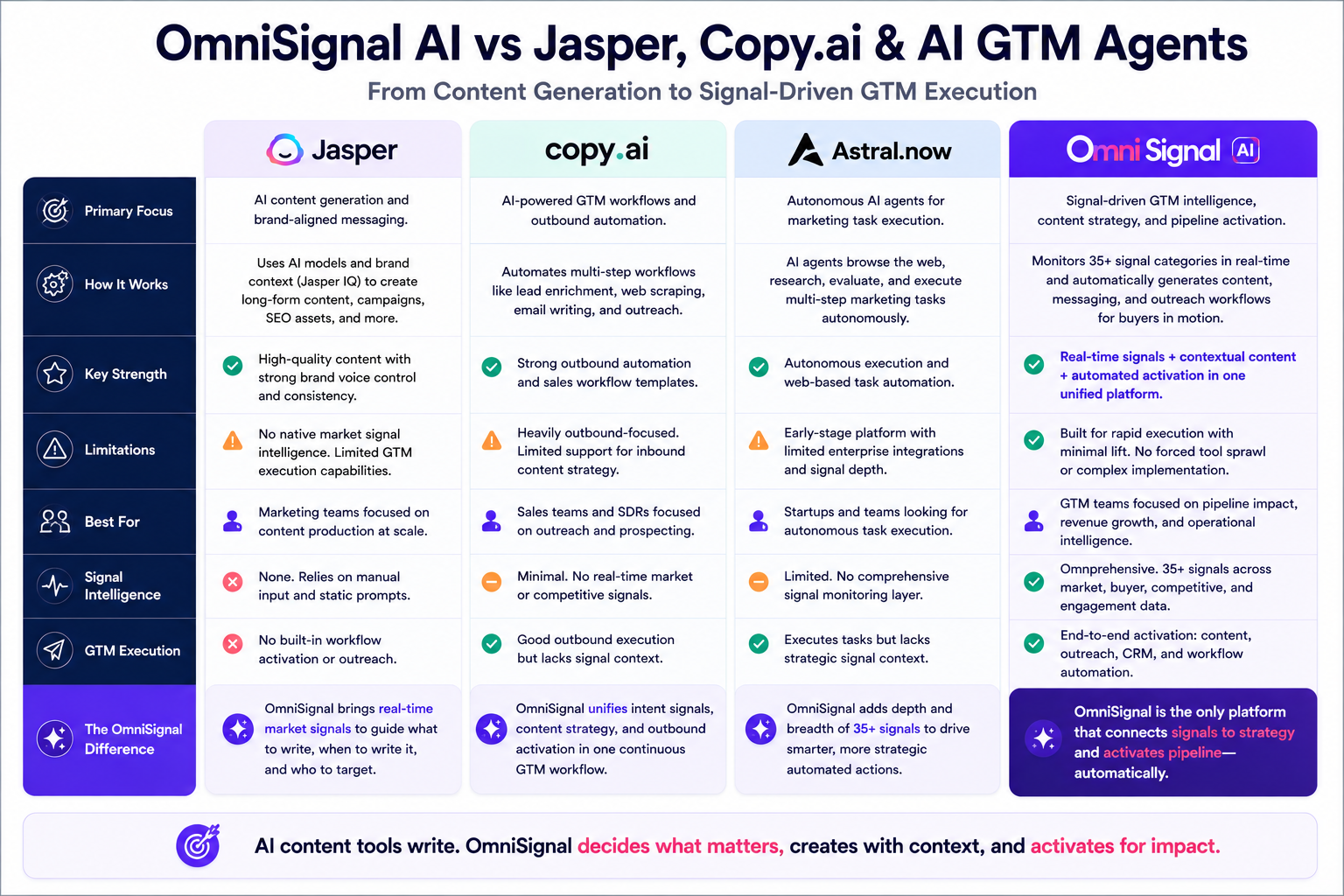
Jasper became one of the leading AI writing platforms for enterprise marketing teams focused on:
- SEO content
- long-form writing
- campaign creation
- brand consistency
Copy.ai evolved toward AI-powered GTM workflow automation, focusing heavily on outbound sales workflows and prospecting automation.
Emerging platforms like Astral.now introduced autonomous browser agents capable of executing multi-step marketing workflows.
Why AI Content Alone Isn’t Enough
Generative AI without real-time market context creates a major problem:
The Sea of Sameness
Most AI-generated content today lacks:
- timing relevance
- buyer context
- competitive awareness
- signal prioritization
- strategic differentiation
AI tools can generate content quickly.
But they rarely answer the harder question:
What should your team create today — and why now?
How OmniSignal Solves This
OmniSignal AI solves the “cold start” problem in AI marketing.
Instead of waiting for marketers to manually prompt content tools, OmniSignal continuously monitors external GTM signals and automatically prioritizes:
- content opportunities
- narrative angles
- competitor positioning
- campaign timing
- buyer pain points
This ensures every content workflow is tied directly to active market movements.
Instead of producing generic SEO articles, OmniSignal creates:
- signal-driven inbound content
- contextual thought leadership
- market-timed outreach
- dynamic GTM narratives
that align directly with real buyer behavior.
OmniSignal AI vs Klue, Crayon & AlphaSense
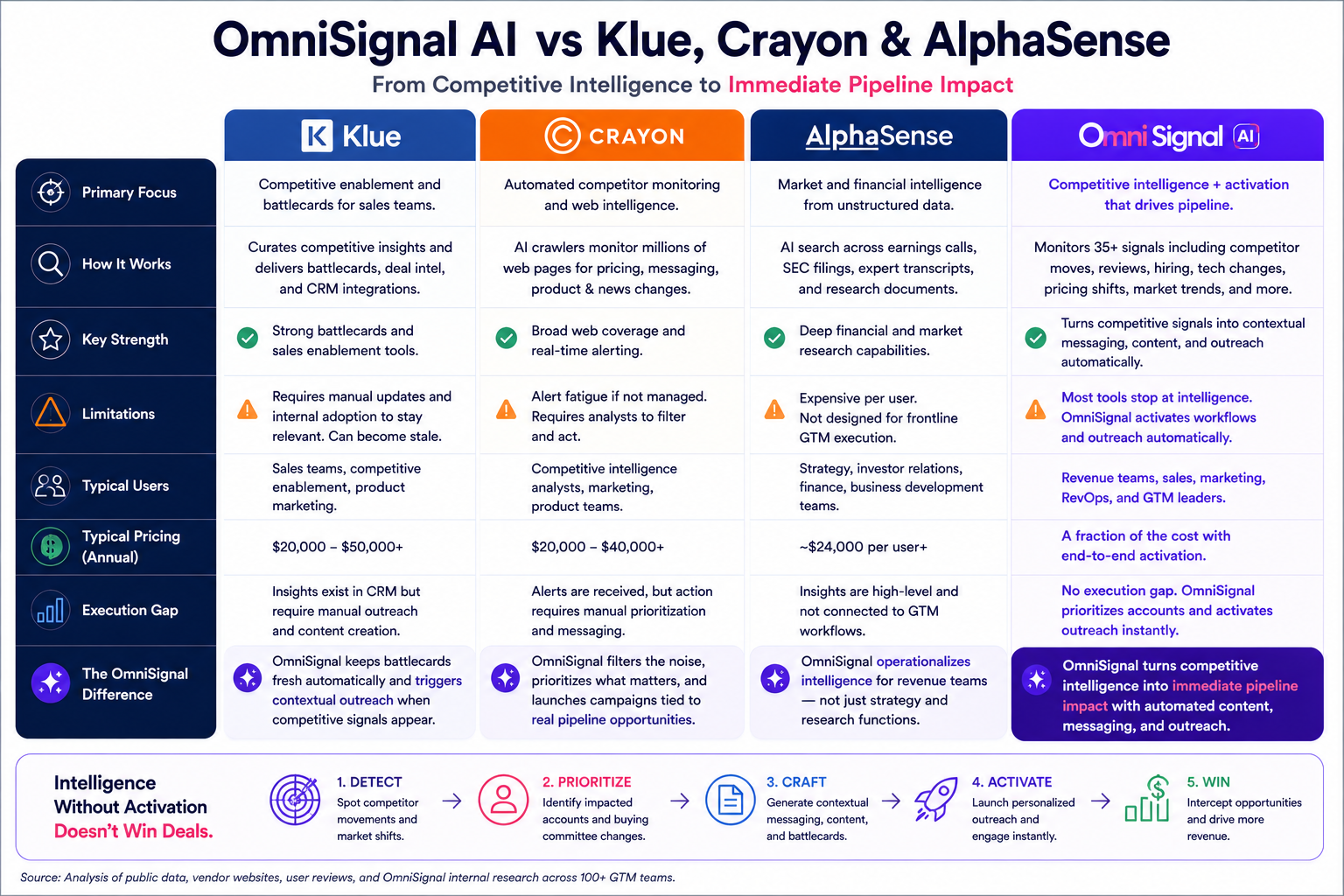
Use Case: Competitive & Market Intelligence
How Traditional Competitive Intelligence Platforms Work
Klue focuses on competitive enablement through battlecards and sales intelligence.
Crayon specializes in automated competitor monitoring across websites, pricing pages, and messaging changes.
AlphaSense provides enterprise-grade AI search across:
- earnings calls
- SEC filings
- analyst reports
- expert transcripts
These platforms excel at surfacing competitive information.
The Execution Gap
Competitive intelligence without activation creates operational drag.
Most teams still need to manually:
- interpret the intelligence
- identify affected accounts
- create messaging
- update positioning
- launch campaigns
- brief sales teams
This slows execution significantly.
How OmniSignal Solves This
OmniSignal transforms competitive intelligence into live GTM activation.
Example signals include:
- negative competitor reviews
- executive hiring shifts
- competitor pricing changes
- technology replacement indicators
- customer dissatisfaction signals
Instead of simply updating battlecards, OmniSignal automatically:
- prioritizes affected accounts
- generates contextual messaging
- creates outreach sequences
- updates GTM positioning
- triggers pipeline workflows
The platform turns market intelligence into immediate execution.
OmniSignal AI vs Taplio, Scripe & Social Growth Platforms
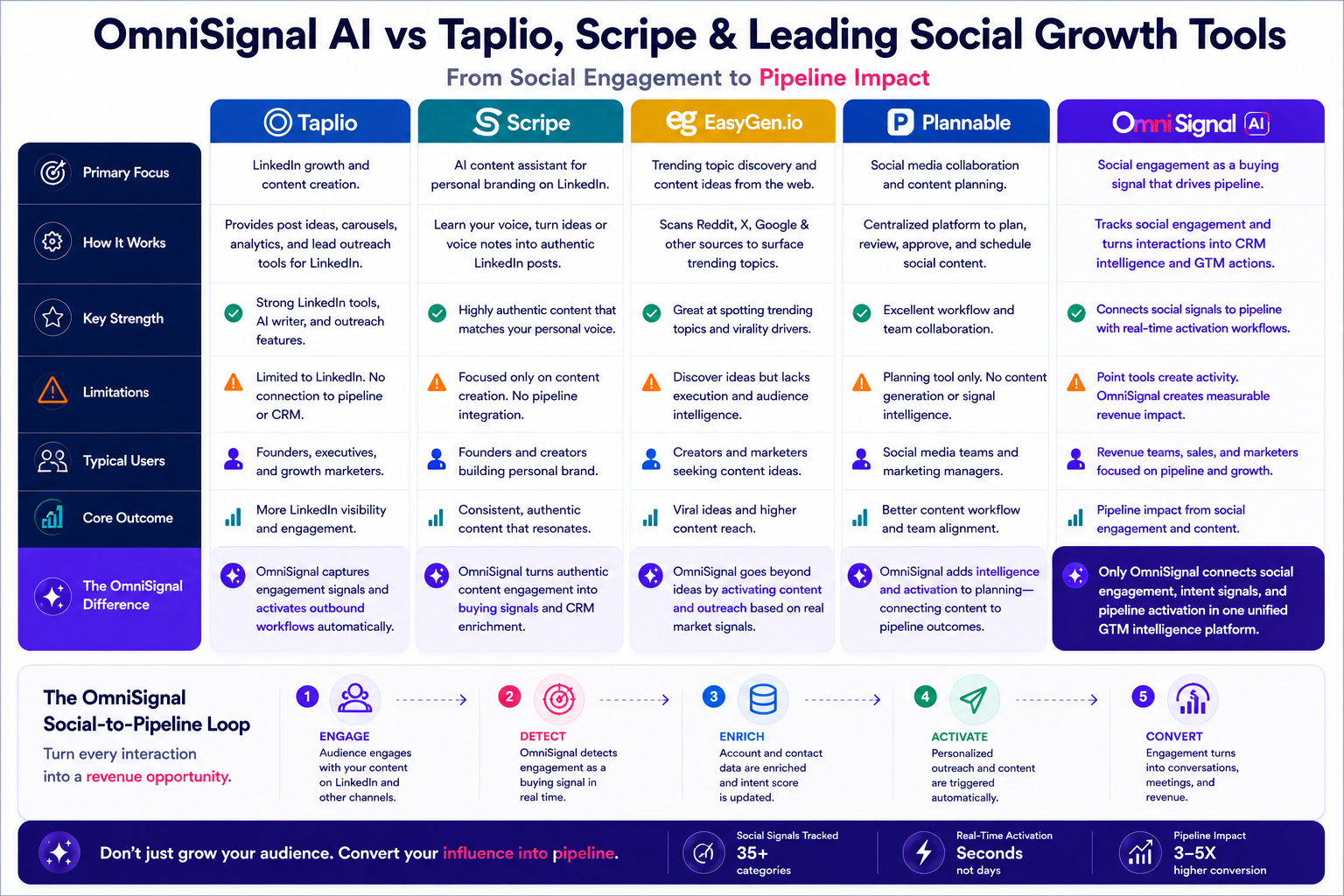
Use Case: LinkedIn Growth & Social Authority
How Traditional Social Growth Tools Work
Platforms like Taplio, Scripe, EasyGen.io, and Buzzli focus heavily on:
- LinkedIn growth
- content generation
- social engagement
- personal branding
- creator workflows
These tools help founders and GTM leaders increase visibility and publishing consistency.
Why Social Growth Alone Doesn’t Create Revenue
Most social platforms optimize for:
- impressions
- likes
- comments
- followers
But social engagement disconnected from pipeline systems creates another operational silo.
A viral post means little if the engagement data never connects to:
- CRM intelligence
- buyer qualification
- outbound workflows
- opportunity creation
How OmniSignal Solves This
OmniSignal treats social engagement as a GTM signal — not just a vanity metric.
Example:
If a target CTO repeatedly engages with:
- cybersecurity thought leadership
- competitor comparisons
- infrastructure migration content
OmniSignal interprets this as a buying signal and automatically:
- enriches the account
- updates buyer context
- prioritizes outreach timing
- activates pipeline workflows
The goal shifts from:
“getting views”
to:
“forecasting pipeline impact.”
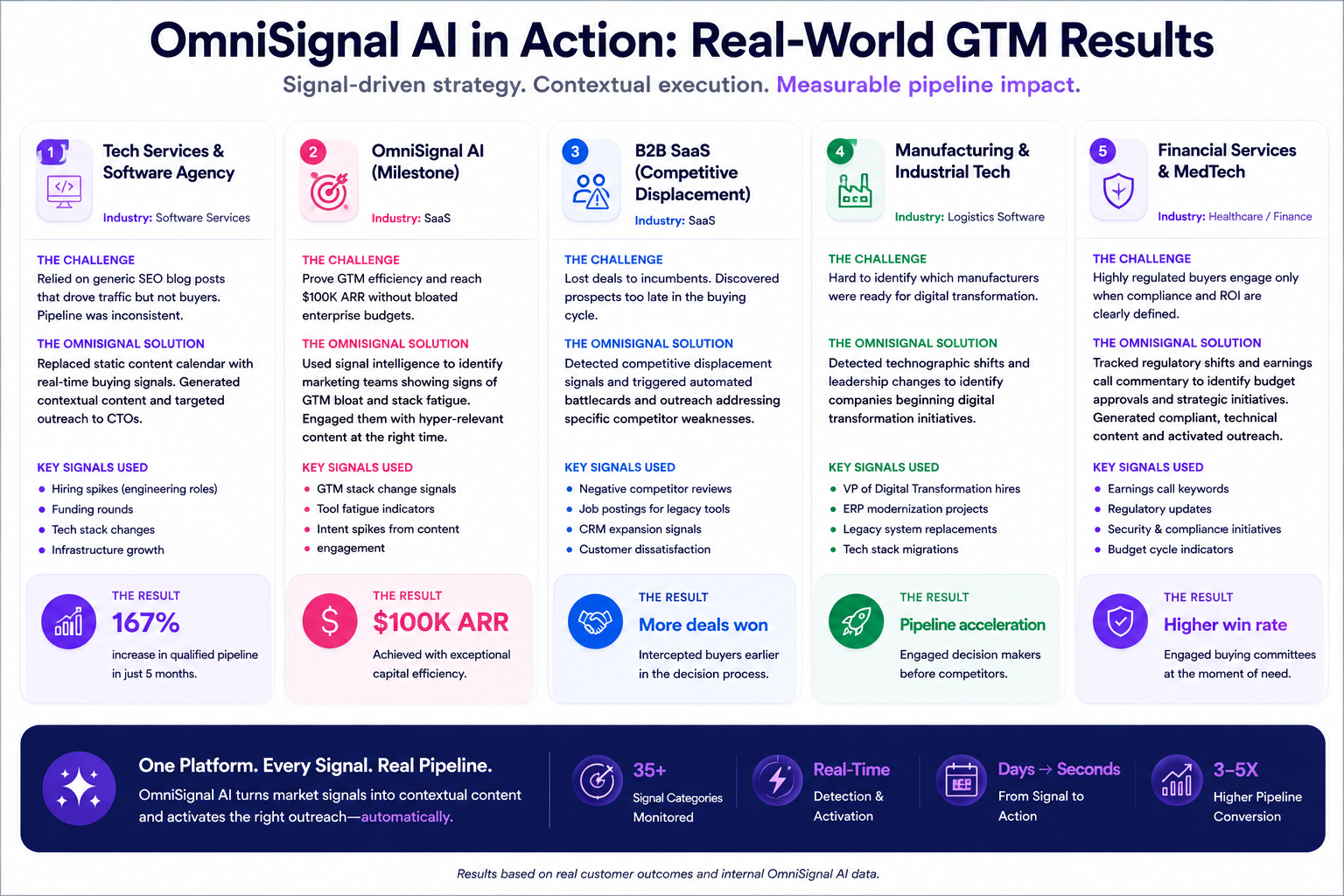
Real-World GTM Case Studies
Software Development Agency
A 35-person software development agency replaced static SEO calendars with OmniSignal’s signal-driven inbound workflows.
Instead of generic content, the platform prioritized topics based on:
- hiring spikes
- funding rounds
- engineering expansion signals
- infrastructure growth indicators
Within five months, the agency increased qualified pipeline generation by 167%.
Competitive Displacement in B2B SaaS
A mid-market SaaS company struggled to compete against large incumbents because they only discovered opportunities after buyers had already entered competitor sales cycles.
OmniSignal detected:
- negative competitor reviews
- outdated technology indicators
- executive hiring changes
- CRM expansion signals
The platform automatically generated:
- competitive messaging
- contextual outreach
- battlecard positioning
- account prioritization
allowing the sales team to intercept buyers earlier in the decision cycle.
Manufacturing & Industrial Technology
A logistics software provider wanted to identify manufacturing companies beginning digital transformation initiatives.
Traditional intent data platforms failed because buyers weren’t actively searching yet.
OmniSignal instead detected:
- new “VP of Digital Transformation” hires
- ERP modernization projects
- legacy infrastructure replacement signals
This allowed the company to launch highly contextual outbound and inbound campaigns before competitors identified the opportunity.
Why Unified GTM Intelligence Wins in 2026
Modern GTM teams no longer suffer from a lack of tools.
They suffer from fragmented intelligence.
Point solutions like 6sense, Jasper, Klue, Taplio, and Copy.ai solve isolated workflow problems, but they still force teams to manually assemble context before execution can happen.
That operational overhead creates:
- slower decisions
- inconsistent messaging
- duplicated work
- fragmented execution
- increasing GTM inefficiency
OmniSignal AI approaches the problem differently.
Instead of adding another dashboard to the stack, it acts as the unified intelligence layer connecting:
- buyer intent
- market shifts
- competitive intelligence
- AI content strategy
- social engagement
- pipeline activation
- outreach orchestration
into one continuous GTM execution system.
As AI search, autonomous workflows, and signal-driven marketing continue evolving, the companies that win in 2026 will not be the ones with the most tools.
They will be the ones with the clearest operational intelligence layer.
FAQ
What is signal-driven inbound marketing?
Signal-driven inbound marketing is a GTM strategy that uses real-time market signals — such as hiring activity, funding events, competitor movements, and buyer behavior — to prioritize content, outreach, and pipeline actions dynamically.
What is the Intelligence Assembly Tax?
The Intelligence Assembly Tax is the operational overhead caused by assembling fragmented context across disconnected GTM systems before teams can execute decisions or campaigns.
How does OmniSignal AI differ from traditional ABM platforms?
Traditional ABM platforms primarily identify intent signals. OmniSignal combines signal detection, AI-powered content strategy, competitive intelligence, and pipeline activation into one unified execution layer.
What are the best AI GTM tools in 2026?
The best AI GTM tools increasingly combine:
- market intelligence
- buyer intent
- workflow orchestration
- contextual content generation
- activation systems
rather than operating as isolated point solutions.
Why are fragmented GTM stacks failing?
Fragmented GTM stacks create operational complexity, slower execution, duplicated work, and inconsistent decision-making because teams must manually connect insights across disconnected tools.