The Intelligence Assembly Tax: The Hidden Cost Slowing Modern Marketing Teams

The Hidden Cost Nobody's Calculating
Most companies think their intelligence problem is a data problem.
It isn’t.
It’s an assembly problem.
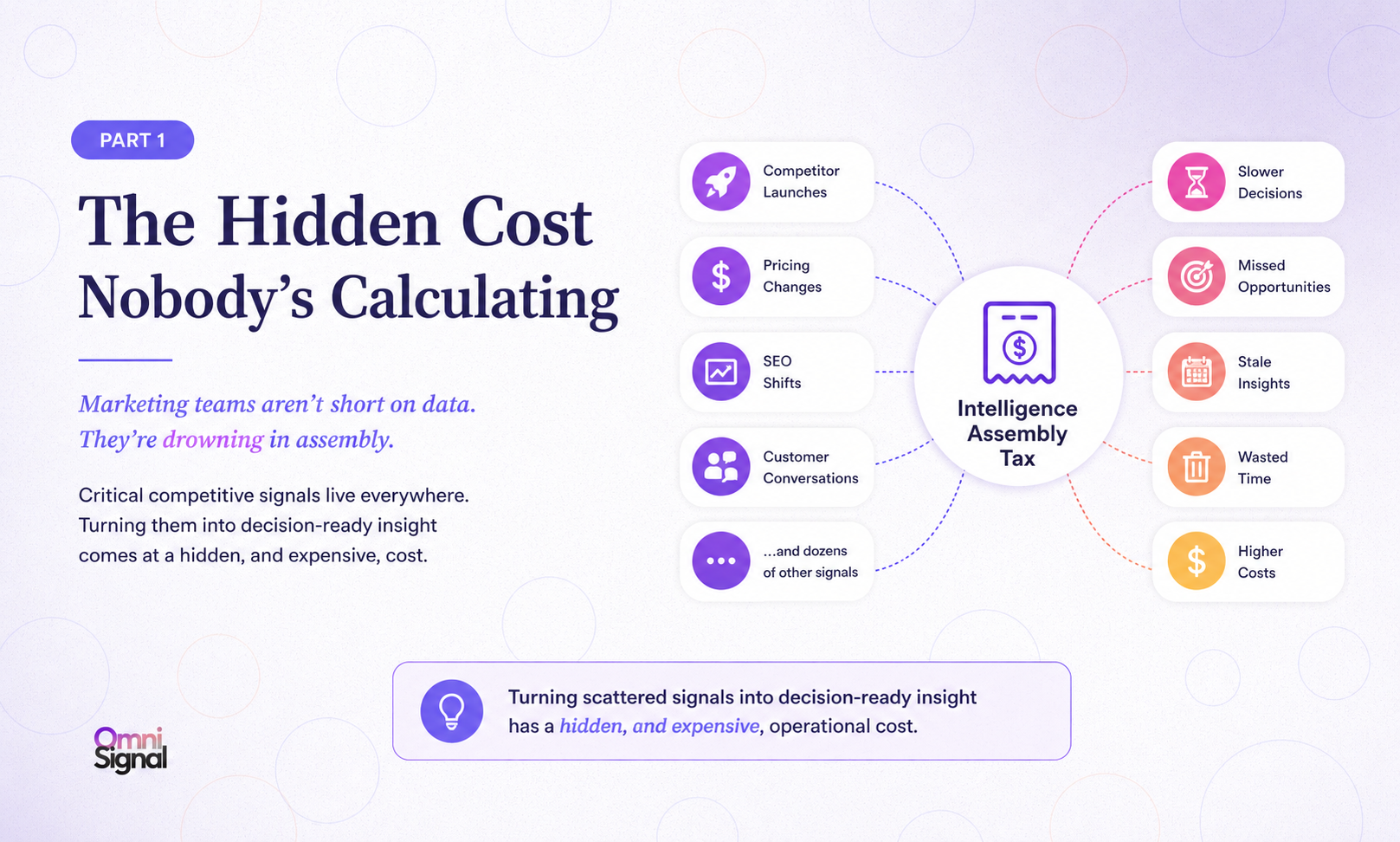
Modern marketing teams are drowning in signals:
- competitor launches
- pricing changes
- SEO movement
- customer conversations
- ad libraries
- analyst reports
- LinkedIn narratives
- product updates
- industry news
The issue isn’t lack of information.
The issue is the operational burden of transforming fragmented signals into something leadership can actually use to make decisions.
That burden has a cost.
We call it the Intelligence Assembly Tax.
And most organizations aren’t measuring it.
How We Discovered Our Own Tax
Last quarter, we audited our own intelligence workflows after killing a product launch tied to stale competitive context.
The insight we relied on was already 11 days old.
That forced us to ask a painful question:
Where did those 11 days actually go?
The answer surprised us.
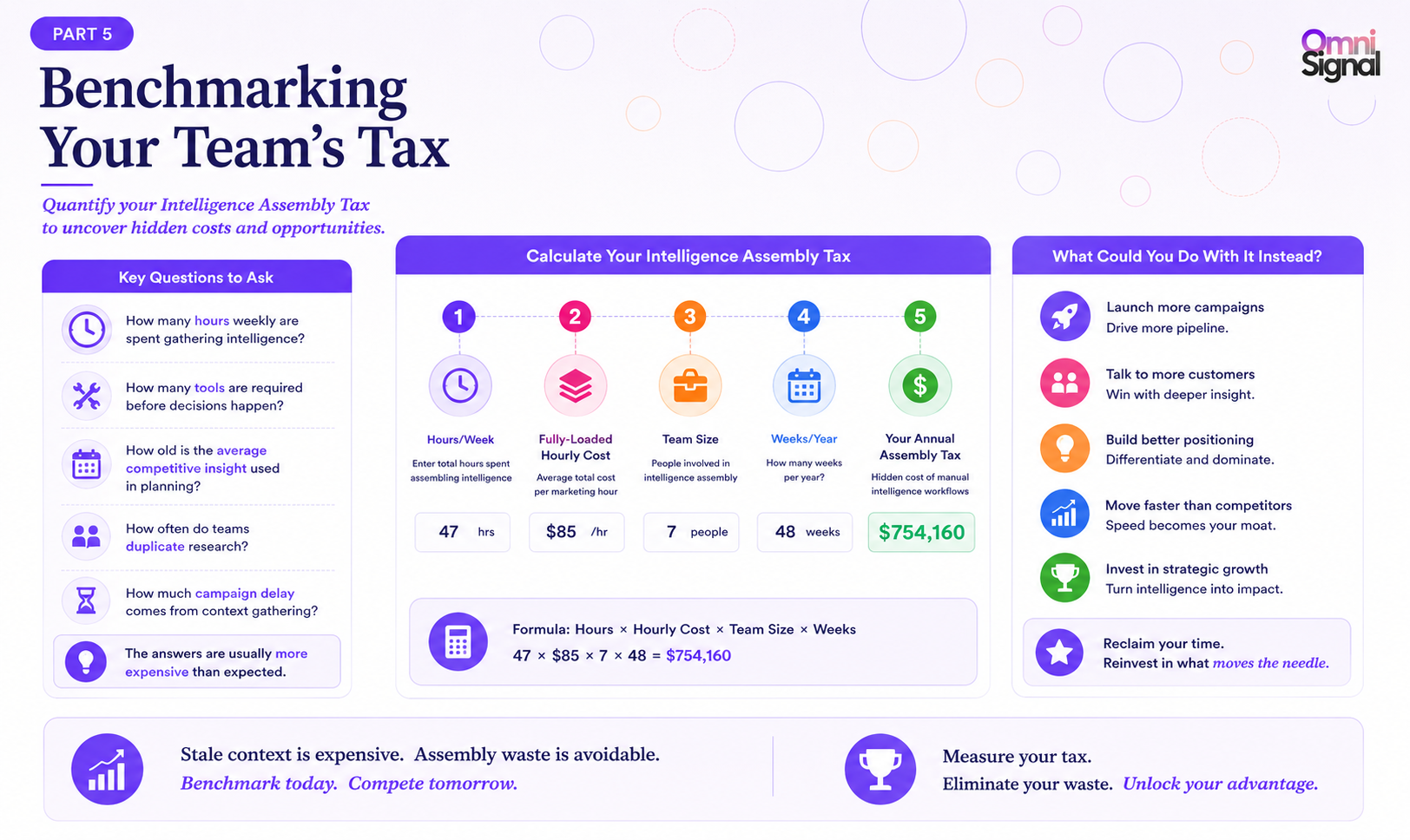
Across a seven-person team, we found:
- 47 hours per week spent assembling intelligence
- dozens of disconnected tools
- duplicated research efforts
- Slack threads replacing institutional memory
- insights trapped in spreadsheets and dashboards
Very little time was spent on actual strategic thinking.
Most of the effort went into collecting, cleaning, organizing, validating, and contextualizing information before decisions could even begin.
That’s when we realized:
The hidden bottleneck wasn’t strategy execution.
It was intelligence assembly.
The Three Components of Assembly Waste
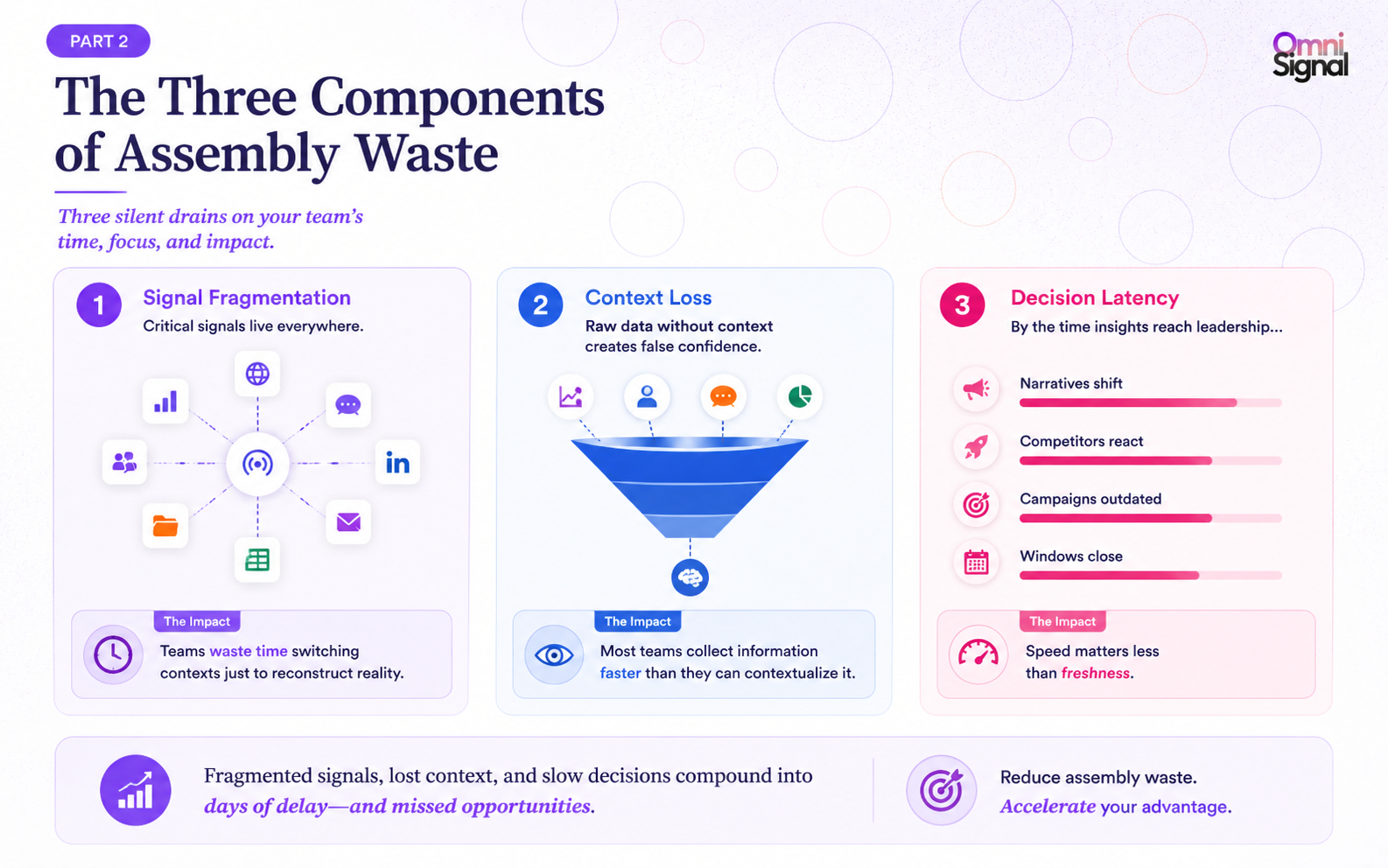
1. Signal Fragmentation
Critical market signals live everywhere:
- CRM systems
- social platforms
- SEO tools
- analytics dashboards
- customer interviews
- sales calls
- internal documents
Teams waste enormous time switching contexts just to reconstruct reality.
2. Context Loss
Raw data without competitive context creates false confidence.
A competitor launching a feature means nothing in isolation.
What matters is:
- how it changes positioning
- whether customers care
- which segment it affects
- whether the narrative is gaining traction
- how your own product compares
Most teams collect information faster than they can contextualize it.
3. Decision Latency
By the time insights reach leadership:
- the narrative has shifted
- competitors have reacted
- campaigns are already outdated
- launch windows have closed
Speed matters less than freshness.
And freshness breaks when intelligence workflows depend on manual assembly.
Why More Headcount Isn't the Answer
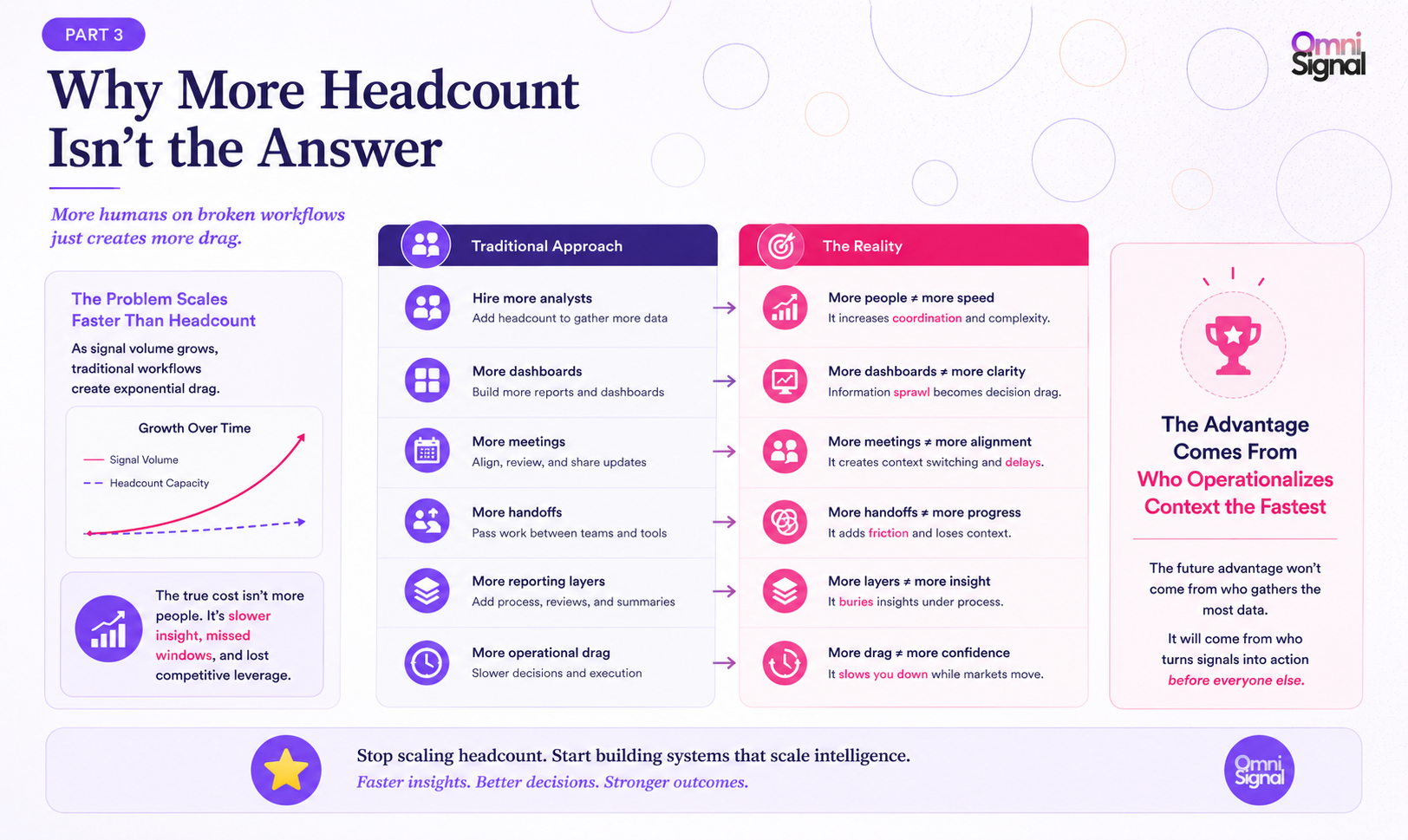
The traditional response is predictable:
Hire more analysts.
But more humans managing fragmented systems usually creates:
- more dashboards
- more meetings
- more handoffs
- more reporting layers
- more operational drag
The problem scales faster than headcount.
As signal volume grows, linear research workflows collapse.
The future advantage won’t come from who gathers the most data.
It will come from who operationalizes context the fastest.
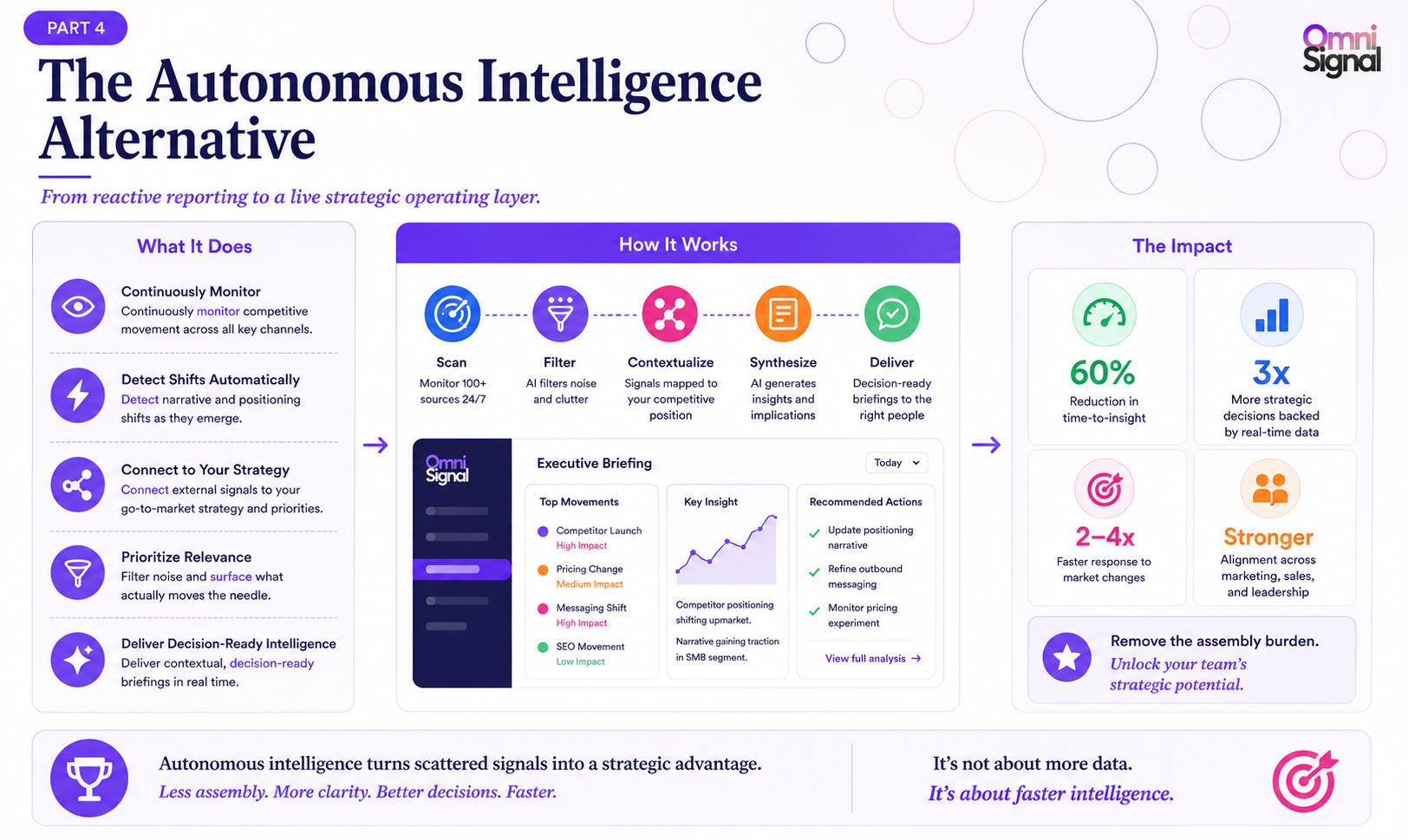
The Autonomous Intelligence Alternative
The next generation of marketing infrastructure won’t just collect signals.
It will:
- continuously monitor competitive movement
- detect narrative shifts automatically
- connect external signals to internal strategy
- prioritize relevance instead of volume
- generate decision-ready intelligence in real time
This changes intelligence from a reactive reporting function into a live strategic operating layer.
Teams using this model report:
- significantly lower time-to-insight
- faster campaign adaptation
- more confident positioning decisions
- better alignment between leadership, marketing, and GTM teams
The goal isn’t replacing marketers.
It’s removing the assembly burden that prevents marketers from thinking strategically.
Benchmarking Your Team's Tax
Most organizations already feel the Intelligence Assembly Tax.
They just haven’t quantified it.
Questions worth asking:
- How many hours weekly are spent gathering intelligence?
- How many tools are required before decisions happen?
- How old is the average competitive insight used in planning?
- How often do teams duplicate research?
- How much campaign delay comes from context gathering?
The answers are usually more expensive than expected.
And in fast-moving markets, stale context compounds quickly.
The cost isn’t only operational.
It’s strategic.
The Real Competitive Advantage
The winning teams over the next decade won’t necessarily create more content.
They’ll operate on fresher context.
Because the companies that reduce intelligence latency move faster, position better, and adapt before competitors realize the market shifted.
That’s the real leverage.
Call to Action
Try OmniSignal’s Intelligence Assembly Cost Calculator to benchmark your team’s hidden tax: