🔐 The New EU Rules on Social Algorithms: What’s Changing — And How Modern Platforms Must Adapt
The EU is tightening rules on social algorithms, banning dark patterns and limiting addictive design. This guide explains what the DSA already requires — and what new regulations platforms must adapt to next.


The EU is reshaping how social platforms recommend content. The Digital Services Act (DSA) is already in force, and the next wave of rules — focused on minors, addictive UX, and “algorithmic fairness” — is coming fast.
Below is a concise breakdown of what matters, and what an ethical, business-oriented platform should already be implementing.
1️⃣ What the DSA Already Requires
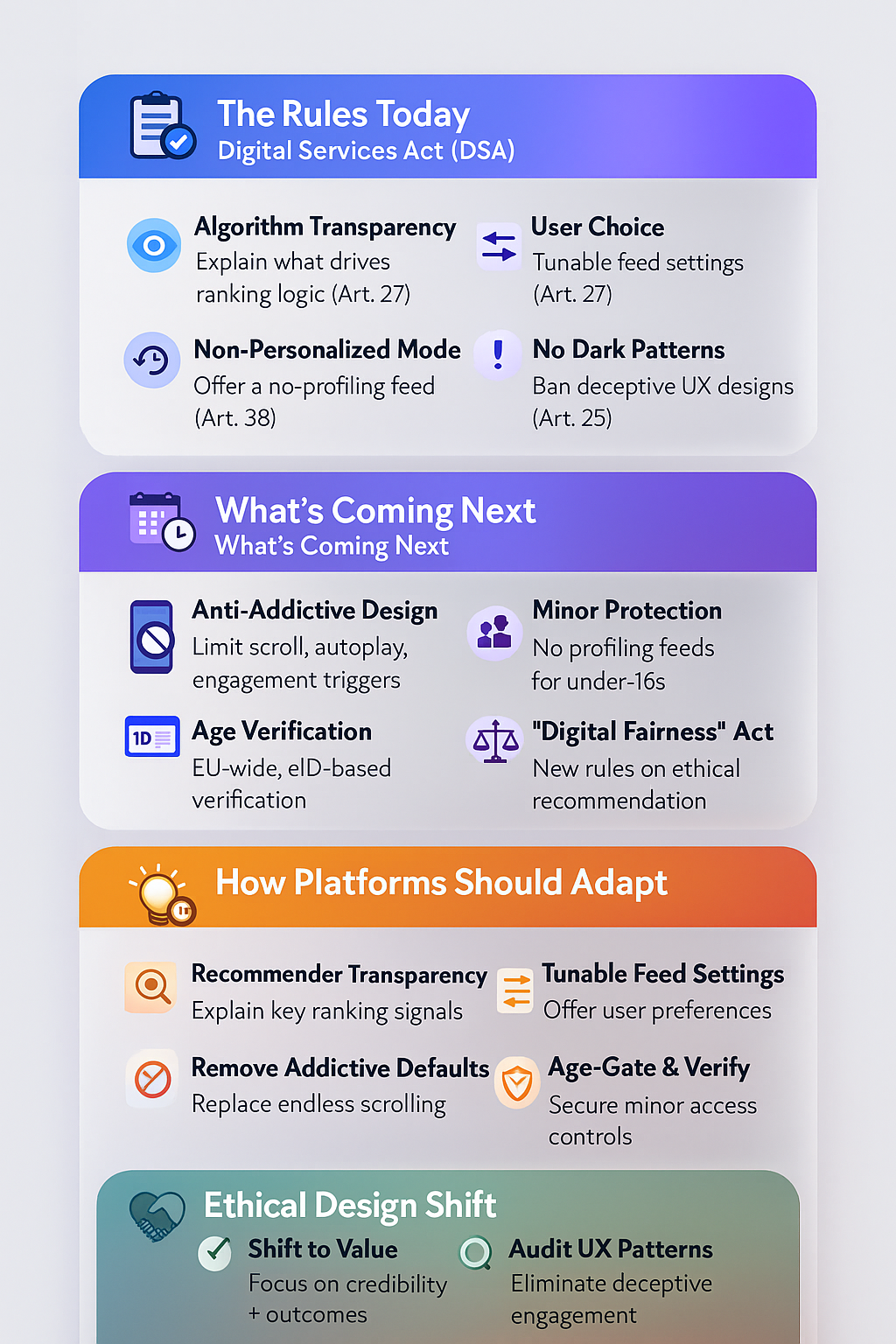
The DSA establishes three core expectations for any platform with algorithmic feeds:
1. Transparency (Art. 27)
Platforms must clearly explain what drives their recommendation logic — e.g., connection strength, content relevance, engagement signals.
2. User Choice (Art. 27)
Users must be able to change their feed settings easily, including toggling how ranking parameters are applied.
3. Non-Personalized Mode (Art. 38)
VLOPs must offer a “no profiling” feed (chronological or neutral).
Even if not mandatory for smaller platforms, it’s quickly becoming a user expectation.
4. No Dark Patterns (Art. 25)
Interfaces can’t hide, mislead, or manipulate. No forced flows. No disguised CTAs. No engagement traps.
Platforms designed for professionals — where value > addiction — naturally sit closer to compliance than mainstream social networks.
2️⃣ What’s Coming Next (2025–2027)
EU policy direction is very clear:
Protect minors. Reduce compulsive interfaces. Increase algorithmic fairness.
Expected measures include:
- Restrictions on addictive design (infinite scroll, autoplay, reward loops)
- A ban on engagement-based recommendations for minors
- EU-wide age verification, tied to eID standards
- A new “Digital Fairness Act”, targeting manipulative UX and opaque algorithmic ranking
Platforms optimized for meaningful interactions and long-term outcomes will have the easiest adaptation curve.
3️⃣ How a Modern Platform Should Prepare (Practical Actions)
A. Implement transparent recommender logic
Provide a clear, human-readable explanation of ranking signals.
B. Offer user-modifiable feed settings
Let people tune connection priority, recency bias, or switch to a neutral feed.
C. Remove addictive defaults
Replace infinite scroll + attention traps with session-based, purpose-driven interactions.
D. Prepare for minor-safe modes
Even if your audience is overwhelmingly professional, age gating and fallback “non-personalized” modes are smart future-proofing.
E. Shift metrics from “attention” to “value”
The EU is indirectly forcing a shift away from maximizing time-on-platform and engagement velocity.
Platforms built around quality signals, credibility, and real outcomes are already aligned with this direction.
Final Note
The regulatory climate is moving toward ethical design by default. Platforms built around meaningful visibility and authentic human interaction are naturally better positioned — not only to comply but to set the new standard for how social recommendation systems should work.
That’s CrossLike.
It helps you plan, launch, and boost your posts automatically — turning every launch into your next growth wave.