OmniSignal’s $100K ARR: The Winning Workflow Behind Our First Revenue Milestone

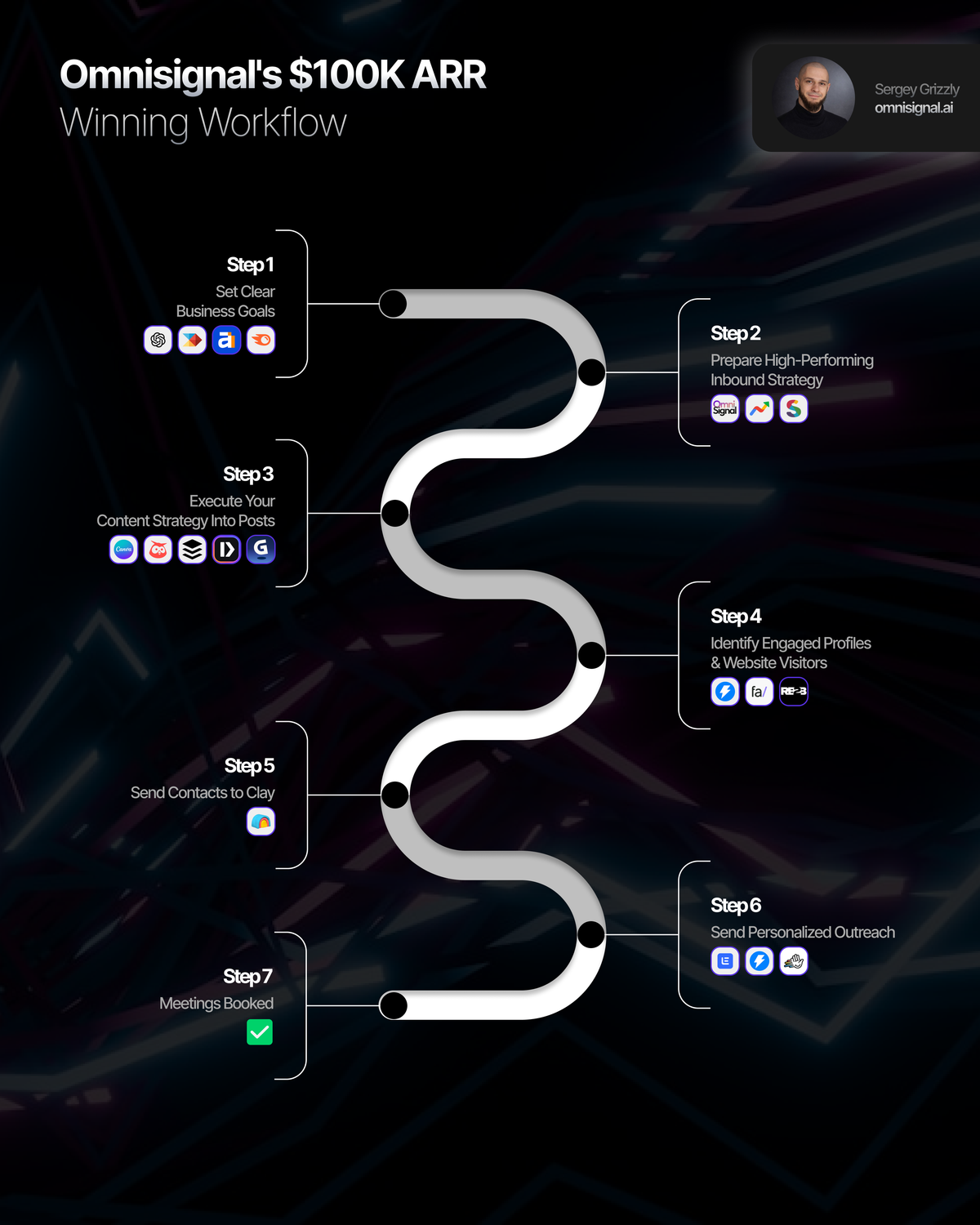
Every GTM system fails if goals are vague.
Before writing a single post, we aligned on:
- who the product is for now
- what success looks like in revenue terms
- which signals actually matter
We used ChatGPT to pressure-test positioning and sharpen assumptions quickly.
Productboard helped us keep product decisions, roadmap, and GTM priorities aligned instead of drifting.
To ground strategy in reality, not opinions:
Without clear goals, content becomes activity.
With clear goals, it becomes leverage.
Step 2: Prepare a High-Performing Inbound Strategy
Inbound doesn’t start with content.
It starts with market movement.
If no one is actively shifting attention, hiring, or behavior — nothing converts.
This is where OmniSignal sits at the core of our workflow. We aggregate signals across competitors, audiences, and trends to understand what is happening right now.
To validate and enrich those signals:
- Google Trends helped us detect early attention shifts
- SparkToro clarified where real conversations were already happening
Inbound works when timing is right.
No timing → no traction.
Step 3: Execute the Content Strategy Into Posts
Content is not the strategy.
It’s the distribution layer.
Once the inbound strategy was clear, execution became mechanical.
We focused on speed, consistency, and clarity:
- Canva enabled fast, repeatable visuals
- Hootsuite kept publishing predictable
- Buffer removed manual friction
- Gamma helped turn ideas into structured narratives
- PlayPlay added lightweight video proof without slowing the team
The key insight:
Content doesn’t create demand — it confirms decisions already forming.

Step 4: Identify Engaged Profiles and Website Visitors
Visibility only matters if you know who engaged.
Instead of chasing vanity metrics, we focused on identifying warm intent:
- Instantly helped capture engagement signals at scale
- Fathom Analytics showed what actually attracted attention
- RB2B connected anonymous website visits to real accounts
At this stage, signals become actionable.
Metrics become leverage.
Step 5: Send Contacts to Clay
Raw engagement is not usable.
We needed a way to turn interest into revenue-ready profiles.
That’s where Clay came in.
Clay allowed us to:
- enrich contacts with deep context
- prioritize based on intent strength
- prepare clean inputs for outbound activation
This is the bridge between “interesting” and “actionable.”

Step 6: Send Personalized Outreach
Outbound didn’t work because it was clever.
It worked because it was timed.
We used:
- lemlist for deep personalization
- Instantly for fast execution at scale
- HeyReach to activate LinkedIn without burning profiles
Same message.
Right moment.
Higher reply rates.

Step 7: Meetings Booked (The Output, Not the Goal)
When the sequence is right, sales feels… easier.
No hacks. No dependence on virality. No “growth tricks.”
Just a workflow where:
- signals guide action
- content validates trust
- outbound activates timing
Meetings are not the objective.
They are the output of a well-ordered system.
Final Thought
$100K ARR didn’t come from doing more.
It came from doing things in the right order.
If you removed one step from this workflow,
where would everything break first?
That question matters more than any tool choice.